 电子书百科大全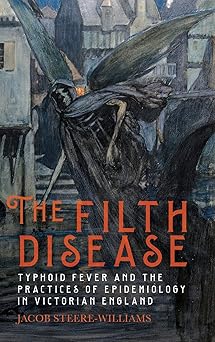
The Filth Disease: Typhoid Fever and the Practices of Epidemiology in Victorian England (Rochester Studies in Medical History, 49)
by: Jacob Steere-Williams (Author)
Publisher: University of Rochester Press
Publication Date: 2020/11/15
Language: English
Print Length: 340 pages
ISBN-10: 1648250025
ISBN-13: 9781648250026
Book Description
Shows how the investigation of local outbreaks of typhoid fever in Victorian Britain led to the emergence of the modern discipline of epidemiology as the leading science of public healthTyphoid fever is a food- and water-borne infectious disease that was insidious and omnipresent in Victorian Britain. It was one of the most prolific diseases of the Industrial Revolution. There was a palpable public anxiety aboutthe disease in the Victorian era, no doubt fueled by media coverage of major outbreaks across the nation, but also because Queen Victoria's husband, Prince Albert, died of the disease in 1861. Their son and heir, Prince Albert Edward, contracted and nearly succumbed to typhoid a decade later in 1871. The Filth Disease shows that typhoid was at the center of a number of critical debates about health, science, and governance. Victorian public health reformers, the book argues, working in central and local government, framed typhoid as the most pressing public health problem in order to persuade local officials to implement sanitary infrastructure to prevent the spread of disease. In this period British epidemiologists uncovered how typhoid is spread via food and water supplies, disrupting the longstanding idea that typhoid was spread via filth. In the process the modern disciple of epidemiology emerged as the chief science of public health. Typhoid was as much a social and political problem as it was a scientific one, and The Filth Disease provides a striking reminder of the cultural context in which infectious diseases strike populations and how scientists study them.
About the Author
Shows how the investigation of local outbreaks of typhoid fever in Victorian Britain led to the emergence of the modern discipline of epidemiology as the leading science of public healthTyphoid fever is a food- and water-borne infectious disease that was insidious and omnipresent in Victorian Britain. It was one of the most prolific diseases of the Industrial Revolution. There was a palpable public anxiety aboutthe disease in the Victorian era, no doubt fueled by media coverage of major outbreaks across the nation, but also because Queen Victoria's husband, Prince Albert, died of the disease in 1861. Their son and heir, Prince Albert Edward, contracted and nearly succumbed to typhoid a decade later in 1871. The Filth Disease shows that typhoid was at the center of a number of critical debates about health, science, and governance. Victorian public health reformers, the book argues, working in central and local government, framed typhoid as the most pressing public health problem in order to persuade local officials to implement sanitary infrastructure to prevent the spread of disease. In this period British epidemiologists uncovered how typhoid is spread via food and water supplies, disrupting the longstanding idea that typhoid was spread via filth. In the process the modern disciple of epidemiology emerged as the chief science of public health. Typhoid was as much a social and political problem as it was a scientific one, and The Filth Disease provides a striking reminder of the cultural context in which infectious diseases strike populations and how scientists study them. Read more
The Filth Disease: Typhoid Fever and the Practices of Epidemiology in Victorian England (Rochester Studies in Medical History, 49)
未经允许不得转载:电子书百科大全 » The Filth Disease: Typhoid Fever and the Practices of Epidemiology in Victorian England (Rochester Studies in Medical History, 49)
相关推荐
 The History of Anti-Semitism, Volume 3: From Voltaire to Wagner
 International Solidarity in the Low Countries during the Twentieth Century: New Perspectives and Themes
 300 Years of the French in Old Mines: A Narrative History of the Oldest Village in Missouri
 Escape from the Pit: A Woman's Resistance in Nazi-occupied Poland, 1939-1943 (Excelsior Editions)
 Alexandrine Teaching on the Universe (Routledge Revivals)
 Dynamic Repetition: History and Messianism in Modern Jewish Thought (The Tauber Institute Series for the Study of European Jewry)
 The Latin Continuation of William of Tyre (Crusade Texts in Translation)
 Shmuel Hugo Bergmann: A Life between Prague and Jerusalem (Europäisch-jüdische Studien – Beiträge, 63)
评论前必须登录!
立即登录 注册