 电子书百科大全
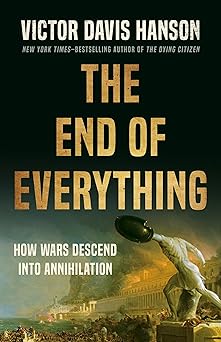 The End of Everything: How Wars Descend into Annihilation
by: Victor Davis Hanson (Author)
Publisher:Basic Books
Publication Date: May 7, 2024
Language:English
Print Length:352 pages
ISBN-10:1541673522
ISBN-13:9781541673526
Book Description
In this “gripping account of catastrophic defeat” (Barry Strauss), a New York Times–bestselling historian charts how and why some societies chose to utterly destroy their foes, and warns that similar wars of obliteration are possible in our time “In The End of Everything, Hanson tells compelling and harrowing stories of how civilizations perished. He helps us consider contemporary affairs in light of that history, think about the unthinkable, and recognize the urgency of trying to prevent our own demise.” — H. R. McMaster, author of Battlegrounds War can settle disputes, topple tyrants, and bend the trajectory of civilization—sometimes to the breaking point. From Troy to Hiroshima, moments when war has ended in utter annihilation have reverberated through the centuries, signaling the end of political systems, cultures, and epochs. Though much has changed over the millennia, human nature remains the same. Modern societies are not immune from the horror of a war of extinction. In The End of Everything, military historian Victor Davis Hanson narrates a series of sieges and sackings that span the age of antiquity to the conquest of the New World to show how societies descend into barbarism and obliteration. In the stories of Thebes, Carthage, Constantinople, and Tenochtitlan, he depicts war’s drama, violence, and folly. Highlighting the naivete that plagued the vanquished and the wrath that justified mass slaughter, Hanson delivers a sobering call to contemporary readers to heed the lessons of obliteration lest we blunder into catastrophe once again.
About the Author
In this “gripping account of catastrophic defeat” (Barry Strauss), a New York Times–bestselling historian charts how and why some societies chose to utterly destroy their foes, and warns that similar wars of obliteration are possible in our time “In The End of Everything, Hanson tells compelling and harrowing stories of how civilizations perished. He helps us consider contemporary affairs in light of that history, think about the unthinkable, and recognize the urgency of trying to prevent our own demise.” — H. R. McMaster, author of Battlegrounds War can settle disputes, topple tyrants, and bend the trajectory of civilization—sometimes to the breaking point. From Troy to Hiroshima, moments when war has ended in utter annihilation have reverberated through the centuries, signaling the end of political systems, cultures, and epochs. Though much has changed over the millennia, human nature remains the same. Modern societies are not immune from the horror of a war of extinction. In The End of Everything, military historian Victor Davis Hanson narrates a series of sieges and sackings that span the age of antiquity to the conquest of the New World to show how societies descend into barbarism and obliteration. In the stories of Thebes, Carthage, Constantinople, and Tenochtitlan, he depicts war’s drama, violence, and folly. Highlighting the naivete that plagued the vanquished and the wrath that justified mass slaughter, Hanson delivers a sobering call to contemporary readers to heed the lessons of obliteration lest we blunder into catastrophe once again. Read more
The End of Everything: How Wars Descend into Annihilation
相关推荐
 Polish Theory of History and Metahistory in Topolski, Pomian, and Tokarczuk
- The Barter Economy of the Khmer Rouge Labor Camps
- The Visibility of Modernization in Architecture
- The Cross-Cultural Legacy of Lin Yutang: Critical Perspectives
- Bless Your Heart: A Field Guide to All Things Southern
- Rome in the Tenth Century: A History in Art (British School at Rome Studies)
- Time Machines: Telegraphic Images in Nineteenth-Century France
- Shots Heard Round the World: America, Britain, and Europe in the Revolutionary War
评论前必须登录!
立即登录 注册