 电子书百科大全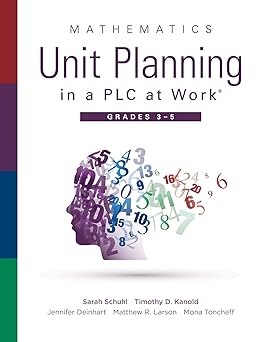
Mathematics Unit Planning in a PLC at Work®, Grades 3-5 (A guide to collaborative teaching and mathematics lesson planning to increase student understanding and expected learning outcomes.)
by: Sarah Schuhl (Author),Timothy D. Kanold(Author),Jennifer Deinhart(Author),Matthew R. Larson(Author),Mona Toncheff(Author)
Publisher: Solution Tree Press
Edition: 1st
Publication Date: 2020/3/27
Language: English
Print Length: 176 pages
ISBN-10: 1951075250
ISBN-13: 9781951075255
Book Description
Build collaborative teacher teams committed to fostering student self-efficacy and increasing achievement in mathematics. Part of the Every Student Can Learn Mathematics series, this practical resource provides a framework for collectively planning a unit of study in grades 3-5. Grade-level teams will learn how to work together to perform key tasks from unwrapping standards and creating team unit calendars to determining academic vocabulary and designing robust fraction units.Help your team identify what students need to know by the end of each unit and build student self-efficacy:Understand how to collaboratively plan thematic units in grades 3-5.Study the seven unit-planning elements and learn how to incorporate each in essential unit design.Review the role of the PLC at Work® process in enhancing collaborative student learning and teacher collaboration.Observe three model fraction units, one for each grade level.Receive tools and templates for effective unit planning.Contents: Introduction by Timothy D. Kanold Part 1: Mathematics Unit Planning and Design Elements Chapter 1: Planning for Student Learning of Mathematics in Grades 3 5 Chapter 2: Unit Planning as a Collaborative Mathematics Team Part 2: Fraction Unit Examples, Grades 3 5 Chapter 3: Grade 3 Unit Fraction Understanding Chapter 4: Grade 4 Unit Fraction Equivalence, Addition, and Subtraction Chapter 5: Grade 5 Unit Fraction Addition and Subtraction Epilogue: Mathematics Team Organization Appendix A: Create a Proficiency Map Appendix B: Checklist and Questions for Mathematics Unit Planning References and Resources
About the Author
Build collaborative teacher teams committed to fostering student self-efficacy and increasing achievement in mathematics. Part of the Every Student Can Learn Mathematics series, this practical resource provides a framework for collectively planning a unit of study in grades 3-5. Grade-level teams will learn how to work together to perform key tasks from unwrapping standards and creating team unit calendars to determining academic vocabulary and designing robust fraction units.Help your team identify what students need to know by the end of each unit and build student self-efficacy:Understand how to collaboratively plan thematic units in grades 3-5.Study the seven unit-planning elements and learn how to incorporate each in essential unit design.Review the role of the PLC at Work® process in enhancing collaborative student learning and teacher collaboration.Observe three model fraction units, one for each grade level.Receive tools and templates for effective unit planning.Contents: Introduction by Timothy D. Kanold Part 1: Mathematics Unit Planning and Design Elements Chapter 1: Planning for Student Learning of Mathematics in Grades 3 5 Chapter 2: Unit Planning as a Collaborative Mathematics Team Part 2: Fraction Unit Examples, Grades 3 5 Chapter 3: Grade 3 Unit Fraction Understanding Chapter 4: Grade 4 Unit Fraction Equivalence, Addition, and Subtraction Chapter 5: Grade 5 Unit Fraction Addition and Subtraction Epilogue: Mathematics Team Organization Appendix A: Create a Proficiency Map Appendix B: Checklist and Questions for Mathematics Unit Planning References and Resources Read more
Mathematics Unit Planning in a PLC at Work®, Grades 3-5 (A guide to collaborative teaching and mathematics lesson planning to increase student understanding and expected learning outcomes.)
未经允许不得转载:电子书百科大全 » Mathematics Unit Planning in a PLC at Work®, Grades 3-5 (A guide to collaborative teaching and mathematics lesson planning to increase student understanding and expected learning outcomes.)
相关推荐
 Real-world Learning Framework for Secondary Schools: Digital Tools and Practical Strategies for Successful Implementation - bring about deeper and self-directed learning in students
 The social world of the school: Education and community in interwar London
 Brain Words: How the Science of Reading Informs Teaching
 Periodization and Sovereignty: How Ideas of Feudalism and Secularization Govern the Politics of Time (The Middle Ages Series)
 Edexcel AS and A Level Modular Mathematics M4
 Theory, Practice, and Trends in Human Services: An Introduction (MindTap Course List)
 The Language of TESOL and Bilingual Education: An Expanded Glossary of Key Terms and Concepts (Language of Education, 4)
 A No-Nonsense Guide to Academic Writing
评论前必须登录!
立即登录 注册