 电子书百科大全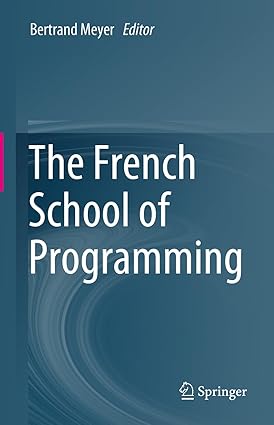
The French School of Programming
by: Bertrand Meyer (Editor)
Publisher: Springer
Edition: 2024th
Publication Date: 2024/4/30
Language: English
Print Length: 463 pages
ISBN-10: 3031345177
ISBN-13: 9783031345173
Book Description
The French School of Programming is a collection of insightful discussions of programming and software engineering topics, by some of the most prestigious names of French computer science. The authors include several of the originators of such widely acclaimed inventions as abstract interpretation, the Caml, OCaml and Eiffel programming languages, the Coq proof assistant, agents and modern testing techniques.The book is divided into four parts: Software Engineering (A), Programming Language Mechanisms and Type Systems (B), Theory (C), and Language Design and Programming Methodology (D). They are preceded by a Foreword by Bertrand Meyer, the editor of the volume, a Preface by Jim Woodcock providing an outsider’s appraisal of the French school’s contribution, and an overview chapter by Gérard Berry, recalling his own intellectual journey. Chapter 2, by Marie-Claude Gaudel, presents a 30-year perspective on the evolution of testing starting with her own seminal work. In chapter 3, Michel Raynal covers distributed computing with an emphasis on simplicity. Chapter 4, by Jean-Marc Jézéquel, former director of IRISA, presents the evolution of modeling, from CASE tools to SLE and Machine Learning. Chapter 5, by Joëlle Coutaz, is a comprehensive review of the evolution of Human-Computer Interaction. In part B, chapter 6, by Jean-Pierre Briot, describes the sequence of abstractions that led to the concept of agent. Chapter 7, by Pierre-Louis Curien, is a personal account of a journey through fundamental concepts of semantics, syntax and types. In chapter 8, Thierry Coquand presents “some remarks on dependent type theory”. Part C begins with Patrick Cousot’s personal historical perspective on his well-known creation, abstract interpretation, in chapter 9. Chapter 10, by Jean-Jacques Lévy, is devoted to tracking redexes in the Lambda Calculus. The final chapter of that part, chapter 11 by Jean-Pierre Jouannaud, presents advances in rewriting systems, specifically the confluence of terminating rewriting computations. Part D contains two longer contributions. Chapter 12 is a review by Giuseppe Castagna of a broad range of programming topics relying on union, intersection and negation types. In the final chapter, Bertrand Meyer covers “ten choices in language design” for object-oriented programming, distinguishing between “right” and “wrong” resolutions of these issues and explaining the rationale behind Eiffel’s decisions.This book will be of special interest to anyone with an interest in modern views of programming ― on such topics as programming language design, the relationship between programming and type theory, object-oriented principles, distributed systems, testing techniques, rewriting systems, human-computer interaction, software verification… ― and in the insights of a brilliant group of innovators in the field.
About the Author
The French School of Programming is a collection of insightful discussions of programming and software engineering topics, by some of the most prestigious names of French computer science. The authors include several of the originators of such widely acclaimed inventions as abstract interpretation, the Caml, OCaml and Eiffel programming languages, the Coq proof assistant, agents and modern testing techniques.The book is divided into four parts: Software Engineering (A), Programming Language Mechanisms and Type Systems (B), Theory (C), and Language Design and Programming Methodology (D). They are preceded by a Foreword by Bertrand Meyer, the editor of the volume, a Preface by Jim Woodcock providing an outsider’s appraisal of the French school’s contribution, and an overview chapter by Gérard Berry, recalling his own intellectual journey. Chapter 2, by Marie-Claude Gaudel, presents a 30-year perspective on the evolution of testing starting with her own seminal work. In chapter 3, Michel Raynal covers distributed computing with an emphasis on simplicity. Chapter 4, by Jean-Marc Jézéquel, former director of IRISA, presents the evolution of modeling, from CASE tools to SLE and Machine Learning. Chapter 5, by Joëlle Coutaz, is a comprehensive review of the evolution of Human-Computer Interaction. In part B, chapter 6, by Jean-Pierre Briot, describes the sequence of abstractions that led to the concept of agent. Chapter 7, by Pierre-Louis Curien, is a personal account of a journey through fundamental concepts of semantics, syntax and types. In chapter 8, Thierry Coquand presents “some remarks on dependent type theory”. Part C begins with Patrick Cousot’s personal historical perspective on his well-known creation, abstract interpretation, in chapter 9. Chapter 10, by Jean-Jacques Lévy, is devoted to tracking redexes in the Lambda Calculus. The final chapter of that part, chapter 11 by Jean-Pierre Jouannaud, presents advances in rewriting systems, specifically the confluence of terminating rewriting computations. Part D contains two longer contributions. Chapter 12 is a review by Giuseppe Castagna of a broad range of programming topics relying on union, intersection and negation types. In the final chapter, Bertrand Meyer covers “ten choices in language design” for object-oriented programming, distinguishing between “right” and “wrong” resolutions of these issues and explaining the rationale behind Eiffel’s decisions.This book will be of special interest to anyone with an interest in modern views of programming ― on such topics as programming language design, the relationship between programming and type theory, object-oriented principles, distributed systems, testing techniques, rewriting systems, human-computer interaction, software verification… ― and in the insights of a brilliant group of innovators in the field. Read more
The French School of Programming
未经允许不得转载:电子书百科大全 » The French School of Programming
相关推荐
 Machine Learning for Healthcare Informatics: Techniques and Applications
- Deep Learning Approaches in Intelligent Wireless Networking
- Logic For Dummies, 2nd Edition
- Mathematics of Time Series Forecasting: Build Robust Time Series Forecasting Systems in Python Using Mathematical Theory, Statistical Modeling, Machine Learning, and Deep Learning
- SQR in PeopleSoft and Other Applications: PeopleSoft v.8, 2nd Edition
- Modern Python Cookbook: 130+ updated recipes for modern Python 3.12 with new techniques and tools
- Introduction to Modern Scientific Programming and Numerical Methods
- Basics of Python Programming: Learn Python in 30 days (Beginners approach) - 2nd Edition
评论前必须登录!
立即登录 注册