 电子书百科大全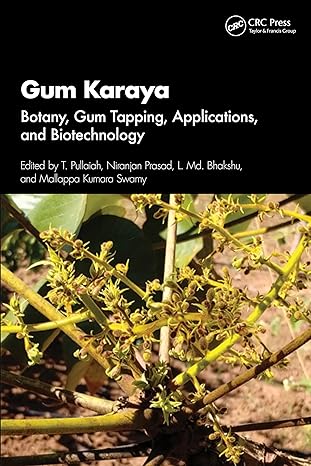
Gum Karaya: Botany, Gum Tapping, Applications, and Biotechnology
by: T. Pullaiah (Editor),Niranjan Prasad (Editor),L. Md. Bhakshu (Editor),Mallappa Kumara Swamy (Editor)&1more
Publisher:
Edition: 1st
Publication Date: 2024/8/27
Language: English
Print Length: 176 pages
ISBN-10: 1032573430
ISBN-13: 9781032573434
Book Description
Polysaccharide gums have a wide range of applications due to their hydrophilic properties. They have been used as a gelling agent, encapsulating agent, thickener, emulsifier, and stabilizer. Sourcing natural gums from botanical and plant sources has become an important focus in producing acceptable food ingredients in liquids and semi-solid forms. This is mainly because of the positive attitude of consumers toward plant-based gums rather than other gums from animal and microbial sources.Gum karaya, also known as Indian tragacanth, is a vegetable gum produced as an exudate by trees of the genus Sterculia. Gum karaya has very strong swelling properties, high viscosity, and very poor solubility because of its acetyl groups. Therefore, it is mainly used in cosmetics and pharmaceuticals. Gum karaya is one of the least-soluble gums used for many industries, such as petroleum and gas, textile, paper and pulp, leather and allied products, ammunition and explosives, electrical appliances, adhesives, confectionery, medicine, pharmaceuticals, and cosmetics.Because of the crude tapping method and overexploitation, the population of karaya trees has markedly declined. In the absence of cultivation of this tree on the regular plantation, there is grave concern about the loss of wild germplasm of S. aurens. As gum karaya is vital for the tribal economy and its trade value is substantial, there is a pressing need to develop a scientific and sustainable tapping method to increase the yield and ensure the survival of the tapped trees. There is also a need for a large-scale plantation of gum karaya. People are becoming health-conscious and are taking natural products as food ingredients. This book will be useful to all the people interested in natural food additives.This book gives the details of gum karaya–yielding species and their distribution.Scientific methods of gum tapping are given for sustainable gum production.Propagation methods, both field and in vitro, are given.Uses of gum karaya, in cosmetics, pharmaceuticals, and food, are given.Genetic diversity and biotechnological intervention for the improvement of gum karaya–yielding species are included.Threats and conservation of gum karaya–yielding species are given.
About the Author
Polysaccharide gums have a wide range of applications due to their hydrophilic properties. They have been used as a gelling agent, encapsulating agent, thickener, emulsifier, and stabilizer. Sourcing natural gums from botanical and plant sources has become an important focus in producing acceptable food ingredients in liquids and semi-solid forms. This is mainly because of the positive attitude of consumers toward plant-based gums rather than other gums from animal and microbial sources.Gum karaya, also known as Indian tragacanth, is a vegetable gum produced as an exudate by trees of the genus Sterculia. Gum karaya has very strong swelling properties, high viscosity, and very poor solubility because of its acetyl groups. Therefore, it is mainly used in cosmetics and pharmaceuticals. Gum karaya is one of the least-soluble gums used for many industries, such as petroleum and gas, textile, paper and pulp, leather and allied products, ammunition and explosives, electrical appliances, adhesives, confectionery, medicine, pharmaceuticals, and cosmetics.Because of the crude tapping method and overexploitation, the population of karaya trees has markedly declined. In the absence of cultivation of this tree on the regular plantation, there is grave concern about the loss of wild germplasm of S. aurens. As gum karaya is vital for the tribal economy and its trade value is substantial, there is a pressing need to develop a scientific and sustainable tapping method to increase the yield and ensure the survival of the tapped trees. There is also a need for a large-scale plantation of gum karaya. People are becoming health-conscious and are taking natural products as food ingredients. This book will be useful to all the people interested in natural food additives.This book gives the details of gum karaya–yielding species and their distribution.Scientific methods of gum tapping are given for sustainable gum production.Propagation methods, both field and in vitro, are given.Uses of gum karaya, in cosmetics, pharmaceuticals, and food, are given.Genetic diversity and biotechnological intervention for the improvement of gum karaya–yielding species are included.Threats and conservation of gum karaya–yielding species are given. Read more
Gum Karaya: Botany, Gum Tapping, Applications, and Biotechnology
相关推荐
 Comprehensive Analysis and Computing of Real-World Medical Images: Second MICCAI Challenge, CARE 2025, Held in Conjunction with MICCAI 2025, Daejeon, ...
 G Proteins
 Parasites in Our World
 The Biological Activity of Phytochemicals 2011th Edition
 A Primer For Experimental Evolution
 Treatise on Geochemistry 2nd Edition
 The Pharmagellan Guide to Analyzing Biotech Clinical Trials
 Non-invasive Prenatal Screening (NIPS) in Clinical Practice
评论前必须登录!
立即登录 注册