 电子书百科大全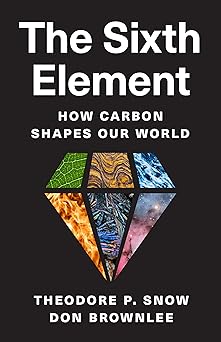
The Sixth Element: How Carbon Shapes Our World
by: Theodore P. Snow (Author),Don Brownlee(Author)
Publisher: Princeton University Press
Publication Date: 2024/6/4
Language: English
Print Length: 264 pages
ISBN-10: 0691125880
ISBN-13: 9780691125886
Book Description
A cosmic perspective on carbon—its importance in the universe and our livesWhen we think of carbon, we might first think of a simple element near the top of the periodic table: symbol C, atomic number 6. Alternatively, we might think of something more tangible—a sooty piece of coal or a sparkling diamond, both made of carbon. Or, as Earth’s temperature continues to rise alarmingly, we might think of the role carbon plays in climate change. Yet carbon’s story begins long ago, far from earthly concerns. In The Sixth Element, astronomers Theodore Snow and Don Brownlee tell the story of carbon from a cosmic perspective—how it was born in the fiery furnaces of stars, what special chemical and physical properties it has, and how it forms the chemical backbone of the planets and all life as we know it. Foundational to every part of our lives, from our bodies to the food, tools, and atmosphere that sustain our existence, carbon is arguably humankind’s most important element.Snow and Brownlee offer readers the ideal introduction to the starry element that made our world possible and shapes our lives. They first discuss carbon’s origin, discovery, and unique ability to bond with other elements and form countless molecules. Next, they reveal carbon’s essential role in the chemical evolution of the universe and the formation and evolution of galaxies, stars, planets, and life, and then, more generally, its technological uses and its influence on Earth’s climate. Bringing readers on a historical, scientific, and cross-disciplinary journey, The Sixth Element illuminates the cosmic wonder that is carbon.
About the Author
A cosmic perspective on carbon—its importance in the universe and our livesWhen we think of carbon, we might first think of a simple element near the top of the periodic table: symbol C, atomic number 6. Alternatively, we might think of something more tangible—a sooty piece of coal or a sparkling diamond, both made of carbon. Or, as Earth’s temperature continues to rise alarmingly, we might think of the role carbon plays in climate change. Yet carbon’s story begins long ago, far from earthly concerns. In The Sixth Element, astronomers Theodore Snow and Don Brownlee tell the story of carbon from a cosmic perspective—how it was born in the fiery furnaces of stars, what special chemical and physical properties it has, and how it forms the chemical backbone of the planets and all life as we know it. Foundational to every part of our lives, from our bodies to the food, tools, and atmosphere that sustain our existence, carbon is arguably humankind’s most important element.Snow and Brownlee offer readers the ideal introduction to the starry element that made our world possible and shapes our lives. They first discuss carbon’s origin, discovery, and unique ability to bond with other elements and form countless molecules. Next, they reveal carbon’s essential role in the chemical evolution of the universe and the formation and evolution of galaxies, stars, planets, and life, and then, more generally, its technological uses and its influence on Earth’s climate. Bringing readers on a historical, scientific, and cross-disciplinary journey, The Sixth Element illuminates the cosmic wonder that is carbon. Read more
The Sixth Element: How Carbon Shapes Our World
相关推荐
 Still As Bright: An Illuminating History of the Moon, from Antiquity to Tomorrow
 Planets, Stars and Stellar Systems: Volume 6: Extragalactic Astronomy and Cosmology 2013th Edition
 Relativistic Heavy-Particle Collision Theory Softcover reprint of the original 1st ed. 2000 Edition
 From Suns to Life: A Chronological Approach to the History of Life on Earth Softcover reprint of the original 1st ed. 2006 Edition
 Edge of the Universe: A Voyage to the Cosmic Horizon and Beyond
 The Andromeda Galaxy and the Rise of Modern Astronomy 2012th Edition
 Exploring the Universe A Journey from Arecibo to FAST: An Introduction into Supersize Radio Telescope Observatories
 The Casual Sky Observer's Guide: Stargazing with Binoculars and Small Telescopes 2012th Edition
评论前必须登录!
立即登录 注册