 电子书百科大全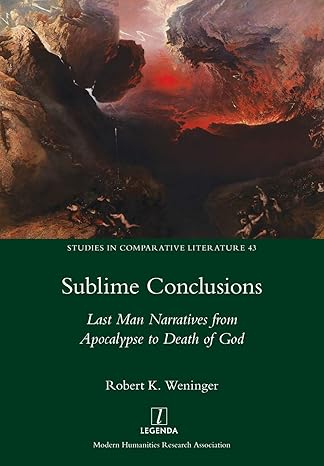
Sublime Conclusions: Last Man Narratives from Apocalypse to Death of God (Studies in Comparative Literature)
by: Robert K Weninger (Author)
Publisher: Legenda
Publication Date: 2019/4/15
Language: English
Print Length: 590 pages
ISBN-10: 1781884234
ISBN-13: 9781781884232
Book Description
One writer, Mary Shelley, inaugurated two of the three paradigms through which human beings imagine, with panic or pleasure, the end of their species. Complementing her visions of a world-encompassing natural plague (The Last Man, 1826) and man-made technological self-eradication (Frankenstein, 1818), the third - and oldest - paradigm of how to depict humankind's demise is the religious notion of Apocalypse, God's Day of Reckoning. Through in-depth philosophical and theological contextualization of the German, French and British literary settings of the apocalyptic tradition around 1800, Sublime Conclusions chronicles the transition from theism and deism to atheism and the 'Death of God' on which, Weninger contends, Shelley's novels - and hence modern science fiction in general - are premised. A tour de force of comparative methodology, Weninger's transdisciplinary approach is as wide-ranging as it is meticulous, interweaving the manifold discourses of catastrophe in literary history, art and film history, philosophy and theology, as well as the history of science and science fiction, across more than two centuries of European intellectual history from Voltaire's mid-eighteenth-century response to the earthquake of Lisbon to Günther Anders's presaging, in the wake of Hiroshima, humankind's extinction through nuclear Armageddon.Robert Weninger is Emeritus Professor of German and Comparative Literature at King's College London.
About the Author
One writer, Mary Shelley, inaugurated two of the three paradigms through which human beings imagine, with panic or pleasure, the end of their species. Complementing her visions of a world-encompassing natural plague (The Last Man, 1826) and man-made technological self-eradication (Frankenstein, 1818), the third - and oldest - paradigm of how to depict humankind's demise is the religious notion of Apocalypse, God's Day of Reckoning. Through in-depth philosophical and theological contextualization of the German, French and British literary settings of the apocalyptic tradition around 1800, Sublime Conclusions chronicles the transition from theism and deism to atheism and the 'Death of God' on which, Weninger contends, Shelley's novels - and hence modern science fiction in general - are premised. A tour de force of comparative methodology, Weninger's transdisciplinary approach is as wide-ranging as it is meticulous, interweaving the manifold discourses of catastrophe in literary history, art and film history, philosophy and theology, as well as the history of science and science fiction, across more than two centuries of European intellectual history from Voltaire's mid-eighteenth-century response to the earthquake of Lisbon to Günther Anders's presaging, in the wake of Hiroshima, humankind's extinction through nuclear Armageddon.Robert Weninger is Emeritus Professor of German and Comparative Literature at King's College London. Read more
Sublime Conclusions: Last Man Narratives from Apocalypse to Death of God (Studies in Comparative Literature)
未经允许不得转载:电子书百科大全 » Sublime Conclusions: Last Man Narratives from Apocalypse to Death of God (Studies in Comparative Literature)
相关推荐
 Radiant Cool: A Novel of Theory of Consciousness (Bradford Books)
 The Unthinkable Truth
 The Body in the Bookstore (A Secret Bookcase Mystery)
 Who Killed Una Lynskey?
 A Town Called Treachery
 Baker Street Irregulars: Thirteen Authors With New Takes on Sherlock Holmes
 archipelago
 The Routledge Companion to Global Chaucer (Routledge Literature Companions)
评论前必须登录!
立即登录 注册