 电子书百科大全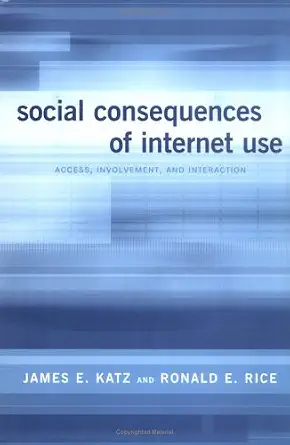
Social Consequences of Internet Use: Access, Involvement, and Interaction
Author(s): James Everett Katz (Author), Ronald E. Rice (Author)
- Publisher: Mit Pr
- Publication Date: September 9, 2002
- Language: English
- Print length: 480 pages
- ISBN-10: 0262112698
- ISBN-13: 9780262112697
Book Description
Drawing on nationally representative telephone surveys conducted from 1995 to 2000, James Katz and Ronald Rice offer a rich and nuanced picture of Internet use in America. Using quantitative data, as well as case studies of Web sites, they explore the impact of the Internet on society from three perspectives: access to Internet technology (the digital divide), involvement with groups and communities through the Internet (social capital), and use of the Internet for social interaction and expression (identity). To provide a more comprehensive account of Internet use, the authors draw comparisons across media and include Internet nonusers and former users in their research.The authors call their research the Syntopia Project to convey the Internet's role as one among a host of communication technologies as well as the synergy between people's online activities and their real-world lives. Their major finding is that Americans use the Internet as an extension and enhancement of their daily routines. Contrary to media sensationalism, the Internet is neither a utopia, liberating people to form a global egalitarian community, nor a dystopia-producing armies of disembodied, lonely individuals. Like any form of communication, it is as helpful or harmful as those who use it.
Editorial Reviews
Editorial Reviews
About the Author
James E. Katz is Chair of the Department of Communication at Rutgers University and director of the Center for Mobile Communication Studies. He is the author of Magic in the Air: Mobile Communication and the Transformation of Social Life and coauthor of Social Consequences of Internet Use (MIT Press, 2002).





评论前必须登录!
立即登录 注册