Semiconductor Memories and Systems provides a comprehensive overview of the current state of semiconductor memory at the technology and system levels. After an introduction on market trends and memory applications, the book focuses on mainstream technologies, illustrating their current status, challenges and opportunities, with special attention paid to scalability paths. Technologies discussed include static random access memory (SRAM), dynamic random access memory (DRAM), non-volatile memory (NVM), and NAND flash memory. Embedded memory and requirements and system level needs for storage class memory are also addressed. Each chapter covers physical operating mechanisms, fabrication technologies, and the main challenges to scalability.Finally, the work reviews the emerging trends for storage class memory, mainly focusing on the advantages and opportunities of phase change based memory technologies.
Features contributions from experts from leading companies in semiconductor memory
Discusses physical operating mechanisms, fabrication technologies and paths to scalability for current and emerging semiconductor memories
Reviews primary memory technologies, including SRAM, DRAM, NVM and NAND flash memory
Includes emerging storage class memory technologies such as phase change memory
Editorial Reviews
Review
Provides a key introduction to the semiconductor memory market led by experts from the top company working in the area
From the Back Cover
The aim of Semiconductor Memories and Systems is to provide a comprehensive overview of the current state of semiconductor memory at the technology and system levels. After an introduction on market trends and memory applications, the book focuses on mainstream technologies illustrating their current status, challenges and opportunities with special attention to their scalability paths.
Technologies discussed include static random access memory (SRAM), dynamic random access memory (DRAM), non-volatile memory (NVM), and NAND flash memory. Embedded memory and requirements and system level needs for storage class memory are also addressed. Each chapter covers physical operating mechanisms, fabrication technologies, and the main challenges to scalability. Finally, the work reviews the emerging trends for storage class memory, mainly focusing on the advantages and opportunities of phase change based memory technologies.
Led by a team of editors from Micron, Semiconductor memories and systems features contributions from top experts working in industry. The book is suitable for engineers in academia and research and development.
About the Author
Andrea Redaelli received the Laurea and Ph.D. degrees in electronic engineering from Politecnico di Milano, Italy, in 2003 and 2007 respectively. During his Ph.D. he worked on Phase Change Memories in the Department of Electrical and Electronic Engineering (Politecnico di Milano), collaborating with the Non-Volatile Memory Technology Development Group of STMicroelectronics, Agrate Brianza. From 2007, he joined STMicroelectronics working on advanced technologies for Non-Volatile memories. From 2008 to 2013 he worked as cell lead engineer on 45 and 26 nm PCM technology developments, firstly as a Numonyx employee and then joined Micron Technology. In the same years, Andrea cooperated with the Department of Electrical Engineering, Politecnico di Milano, in holding master’s classes on electronics and signal conditioning. His work areas included memory array architecture definition, design of test structures, process integration, cell operation modelling and cell electrical testing. He was also the coordinator of a European funded project under FP7 named PASTRY on low power PCM development. Since 2014 Dr. Redaelli has been working on 3DXpointTM technology, in charge of cell stack optimization and pathfinding activities . Dr. Redaelli is also the editor of a book titled “Phase Change Memory: device physics, reliability and applications, he is author and co-author of more than 50 papers, and more than 100 patents and filed patent applications.
Fabio Pellizzer received his M.S. degree in Electronic Engineering in 1996 from the University of Padova, Italy, with a thesis on characterization and reliability of thin gate oxides. In 1998 he joined the Central R&D department of STMicroelectronics in Agrate Brianza (Italy) and worked on the development of several generations of NOR Flash memories, with a focus on gate oxides reliability. Since 2002 he has been in charge of the process development for phase change memories based on chalcogenide materials. Since March 2008 he joined Numonyx as Phase-Change Memory manager in the R&D Technology Development. In May 2011, he joined Micron Technology, where he is responsible for the development of new memory technologies. He is now a Distinguished Member of Technical Staff and Cell Development manager for 3DXPoint technology in Boise (USA). He has authored more than 60 publications on international journals and books and several invited talks at international conferences. He holds more than 130 granted US and European patents on phase-change memories and chalcogenide materials (related to process integration, algorithms and design solutions).
{"@context":"https://schema.org","@type":"Book","name":"Semiconductor Memories and Systems","image":"https://m.media-amazon.com/images/I/41o5WvVbYlL._SY445_SX342_ML2_.jpg","author":{"@type":"Person","name":"Redaelli (Editor), Pellizzer"},"publisher":{"@type":"Organization","name":"Woodhead Publishing"},"datePublished":"9 Jun. 2022","isbn":"9780128207581","numberOfPages":362,"inLanguage":"English","description":"Semiconductor Memories and Systems provides a comprehensive overview of the current state of semiconductor memory at the technology and system levels. After an introduction on market trends and memory applications, the book focuses on mainstream technologies, illustrating their current status, challenges and opportunities, with special attention paid to scalability paths. Technologies discussed include static random access memory (SRAM), dynamic random access memory (DRAM), non-volatile memory (NVM), and NAND flash memory. Embedded memory and requirements and system level needs for storage class memory are also addressed. Each chapter covers physical operating mechanisms, fabrication technologies, and the main challenges to scalability.Finally, the work reviews the emerging trends for storage class memory, mainly focusing on the advantages and opportunities of phase change based memory technologies.Features contributions from experts from leading companies in semiconductor memoryDiscusses physical operating mechanisms, fabrication technologies and paths to scalability for current and emerging semiconductor memoriesReviews primary memory technologies, including SRAM, DRAM, NVM and NAND flash memoryIncludes emerging storage class memory technologies such as phase change memory","url":"https://www.amazon.co.uk/dp/0128207582/","bookFormat":"http://schema.org/EBook","additionalType":"http://schema.org/PDF","fileSize":"82 MB","accessibilityFeature":["login required","member access only"],"accessibilitySummary":"PDF version available to authenticated members only. File size: 82 MB."}
 电子书百科大全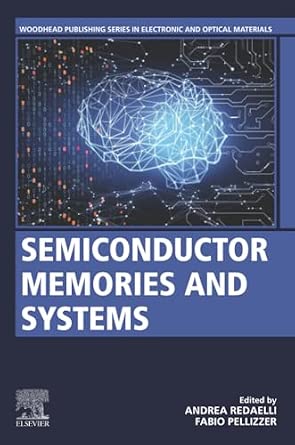



评论前必须登录!
立即登录 注册