 电子书百科大全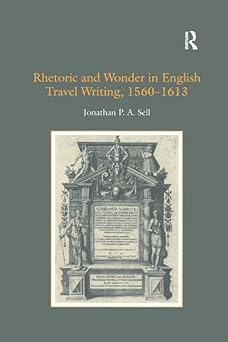
Rhetoric and Wonder in English Travel Writing, 1560-1613
by: Jonathan P.A. Sell (Author)
Publisher:
Edition: 1st
Publication Date: 2019/6/10
Language: English
Print Length: 224 pages
ISBN-10: 1138383805
ISBN-13: 9781138383807
Book Description
Rhetoric and Wonder in English Travel Writing, 1560-1613, shows how rhetorical invention, elocution and ethos combined to create plausible representations by generating intellectual and emotional significances which, meaningful in consensual terms, were 'consensually' true. However, some traveller-writers betrayed an unease with such representation, rooted as it was in a metaphorical epistemology out of kilter with an increasingly empiricist age. This book throws new light onto the episteme shift that ushered in modernity with its distrust of metaphor in particular and rhetoric's 'wordish descriptions' in general. In response to the empirical desiderata of scientific rationalism, traveller-writers textually or physically made their own bodies available as evidence of their encounters with wonder, thus transforming themselves into wonderful objects. The irony is that, far from dispensing with rhetoric, they merely put the accent on its more dramatic arts of gesture and action. The body's evidence could still be doctored, but its illusory truths were better able to satisfy the empirical demand for 'ocular proof'. The author's main purposes here are to complement, and sometimes counter, recent work on early modern travel literature by concentrating on its use of rhetoric to communicate meaning; and to suggest how familiarity with the workings of rhetoric and its communicative and epistemological premises may enhance readings of early modern English literature generally.
About the Author
Rhetoric and Wonder in English Travel Writing, 1560-1613, shows how rhetorical invention, elocution and ethos combined to create plausible representations by generating intellectual and emotional significances which, meaningful in consensual terms, were 'consensually' true. However, some traveller-writers betrayed an unease with such representation, rooted as it was in a metaphorical epistemology out of kilter with an increasingly empiricist age. This book throws new light onto the episteme shift that ushered in modernity with its distrust of metaphor in particular and rhetoric's 'wordish descriptions' in general. In response to the empirical desiderata of scientific rationalism, traveller-writers textually or physically made their own bodies available as evidence of their encounters with wonder, thus transforming themselves into wonderful objects. The irony is that, far from dispensing with rhetoric, they merely put the accent on its more dramatic arts of gesture and action. The body's evidence could still be doctored, but its illusory truths were better able to satisfy the empirical demand for 'ocular proof'. The author's main purposes here are to complement, and sometimes counter, recent work on early modern travel literature by concentrating on its use of rhetoric to communicate meaning; and to suggest how familiarity with the workings of rhetoric and its communicative and epistemological premises may enhance readings of early modern English literature generally. Read more
Rhetoric and Wonder in English Travel Writing, 1560-1613
相关推荐
 Radiant Cool: A Novel of Theory of Consciousness (Bradford Books)
 The Unthinkable Truth
 The Body in the Bookstore (A Secret Bookcase Mystery)
 Who Killed Una Lynskey?
 A Town Called Treachery
 Baker Street Irregulars: Thirteen Authors With New Takes on Sherlock Holmes
 archipelago
 The Routledge Companion to Global Chaucer (Routledge Literature Companions)
评论前必须登录!
立即登录 注册