 电子书百科大全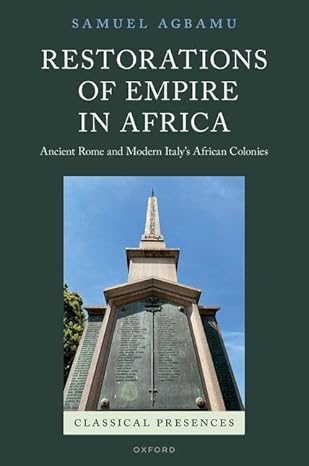
Restorations of Empire in Africa: Ancient Rome and Modern Italy's African Colonies (Classical Presences)
by: Samuel Agbamu (Author)
Publisher: Oxford University Press
Publication Date: 2024/6/28
Language: English
Print Length: 320 pages
ISBN-10: 0192848496
ISBN-13: 9780192848499
Book Description
The histories of Europe and Africa are closely intertwined. At times, this closeness has been emphasized, at other times, suppressed and denied. Since the nineteenth century, European imperial powers have carved up the continent of Africa among themselves, drawing borders and charting shorelines; in the process, inventing Africa. This was a project anchored in ancient Greek and Roman representations of Africa. For Italy, colonialism in Africa was a matter of consolidating its project of national unification, nominally completed in 1870 with the capture of Rome. By asserting its position as an imperial power, the young nation of Italy hoped to join the club of European nation-states and, in so doing, be rid of the perception that it was a country somewhere in between Europe and Africa. Yet, Italy's colonial endeavour in Africa was also a project with deep historical meaning. Italy posed its imperial project in Africa as a national return to territory which was rightfully Italian. Italian ideologues of imperialism based this claim on the history of Roman history on the continent. When Italian soldiers disembarked on the beaches of Libya during Italy's invasion of 1911-1912, and came across the ruins of Roman imperialism, they were, according to prominent cultural and political figures in Italy, rediscovering the traces of their ancestors. Yet, when Italian imperial ambitions set their sights on East Africa, regions that had not been conquered by Rome, how could Italy nevertheless shape its imperial project in the image of ancient Rome?This book charts this story. Beginning with Italy's first imperial endeavours on the African continent in the last decades of the nineteenth century and continuing right through to Italy's current attitudes towards Africa, this book argues that empire in Africa was a central aspect of Italian nation-building, and that this was a project which anchored itself in memories of ancient Rome in Africa. Although Fascism's invasion of Ethiopia (1935-1936) is the best-known moment of Italian imperialism in Africa, this book shows that Italian imperialism, modelled on ancient Rome, has a history which long predates Mussolini's movement, and has a legacy which continues to be acutely felt.
About the Author
The histories of Europe and Africa are closely intertwined. At times, this closeness has been emphasized, at other times, suppressed and denied. Since the nineteenth century, European imperial powers have carved up the continent of Africa among themselves, drawing borders and charting shorelines; in the process, inventing Africa. This was a project anchored in ancient Greek and Roman representations of Africa. For Italy, colonialism in Africa was a matter of consolidating its project of national unification, nominally completed in 1870 with the capture of Rome. By asserting its position as an imperial power, the young nation of Italy hoped to join the club of European nation-states and, in so doing, be rid of the perception that it was a country somewhere in between Europe and Africa. Yet, Italy's colonial endeavour in Africa was also a project with deep historical meaning. Italy posed its imperial project in Africa as a national return to territory which was rightfully Italian. Italian ideologues of imperialism based this claim on the history of Roman history on the continent. When Italian soldiers disembarked on the beaches of Libya during Italy's invasion of 1911-1912, and came across the ruins of Roman imperialism, they were, according to prominent cultural and political figures in Italy, rediscovering the traces of their ancestors. Yet, when Italian imperial ambitions set their sights on East Africa, regions that had not been conquered by Rome, how could Italy nevertheless shape its imperial project in the image of ancient Rome?This book charts this story. Beginning with Italy's first imperial endeavours on the African continent in the last decades of the nineteenth century and continuing right through to Italy's current attitudes towards Africa, this book argues that empire in Africa was a central aspect of Italian nation-building, and that this was a project which anchored itself in memories of ancient Rome in Africa. Although Fascism's invasion of Ethiopia (1935-1936) is the best-known moment of Italian imperialism in Africa, this book shows that Italian imperialism, modelled on ancient Rome, has a history which long predates Mussolini's movement, and has a legacy which continues to be acutely felt. Read more
Restorations of Empire in Africa: Ancient Rome and Modern Italy's African Colonies (Classical Presences)
未经允许不得转载:电子书百科大全 » Restorations of Empire in Africa: Ancient Rome and Modern Italy's African Colonies (Classical Presences)
相关推荐
 Radiant Cool: A Novel of Theory of Consciousness (Bradford Books)
 The Unthinkable Truth
 The Body in the Bookstore (A Secret Bookcase Mystery)
 Who Killed Una Lynskey?
 A Town Called Treachery
 Baker Street Irregulars: Thirteen Authors With New Takes on Sherlock Holmes
 archipelago
 The Routledge Companion to Global Chaucer (Routledge Literature Companions)
评论前必须登录!
立即登录 注册