 电子书百科大全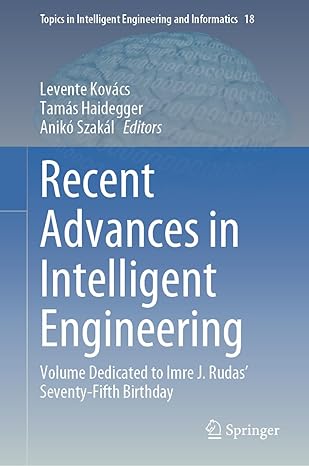
Recent Advances in Intelligent Engineering: Volume Dedicated to Imre J. Rudas’ Seventy-Fifth Birthday (Topics in Intelligent Engineering and Informatics, 18)
by: Levente Kovács (Editor),Tamás Haidegger (Editor),Anikó Szakál (Editor)&0more
Publisher: Springer
Edition: 2024th
Publication Date: 2024/8/7
Language: English
Print Length: 331 pages
ISBN-10: 303158256X
ISBN-13: 9783031582561
Book Description
The book publishes new developments and advances in the various areas of computational intelligence―quickly and with a high quality. The intent is to cover the theory, applications, and design methods of computational intelligence, as embedded in the fields of engineering, computer science, physics, and life science, as well as the methodologies behind them.The book contains monographs, lecture notes, and edited volumes in computational intelligence spanning the areas of neural networks, connectionist systems, genetic algorithms, evolutionary computation, artificial intelligence, cellular automata, self-organizing systems, soft computing, fuzzy systems, and hybrid intelligent systems. Critical to both contributors and readers are the short publication time and world-wide distribution―this permits a rapid and broad disseminational of research results.Soft computing, as a collection of techniques exploiting approximation and tolerance for imprecision and uncertainty in traditionally intractable problems, has become very effective and popular especially because of the synergy derived from its components. The integration of constituent technologies provides complementary methods that allow developing flexible computing tools and solving complex problems. A wide area of natural applications of soft computing techniques consists of the control of dynamic systems, including robots. Loosely speaking, control can be understood as driving a process to attain a desired goal. Intelligent control can be seen as an extension of this concept, to include autonomous human-like interactions of a machine with the environment.Intelligent robots can be characterized by the ability to operate in an uncertain, changing environment with the help of appropriate sensing. They have the power to autonomously plan and execute motion sequences to achieve a goal specified by a human user without detailed instructions. In this book leading specialists address various theoretical and practical aspects in soft computing, intelligent robotics, and control. The problems discussed are taken from fuzzy systems, neural networks, interactive evolutionary computing, intelligent mobile robotics, and intelligent control of linear and nonlinear dynamic systems.
About the Author
The book publishes new developments and advances in the various areas of computational intelligence―quickly and with a high quality. The intent is to cover the theory, applications, and design methods of computational intelligence, as embedded in the fields of engineering, computer science, physics, and life science, as well as the methodologies behind them.The book contains monographs, lecture notes, and edited volumes in computational intelligence spanning the areas of neural networks, connectionist systems, genetic algorithms, evolutionary computation, artificial intelligence, cellular automata, self-organizing systems, soft computing, fuzzy systems, and hybrid intelligent systems. Critical to both contributors and readers are the short publication time and world-wide distribution―this permits a rapid and broad disseminational of research results.Soft computing, as a collection of techniques exploiting approximation and tolerance for imprecision and uncertainty in traditionally intractable problems, has become very effective and popular especially because of the synergy derived from its components. The integration of constituent technologies provides complementary methods that allow developing flexible computing tools and solving complex problems. A wide area of natural applications of soft computing techniques consists of the control of dynamic systems, including robots. Loosely speaking, control can be understood as driving a process to attain a desired goal. Intelligent control can be seen as an extension of this concept, to include autonomous human-like interactions of a machine with the environment.Intelligent robots can be characterized by the ability to operate in an uncertain, changing environment with the help of appropriate sensing. They have the power to autonomously plan and execute motion sequences to achieve a goal specified by a human user without detailed instructions. In this book leading specialists address various theoretical and practical aspects in soft computing, intelligent robotics, and control. The problems discussed are taken from fuzzy systems, neural networks, interactive evolutionary computing, intelligent mobile robotics, and intelligent control of linear and nonlinear dynamic systems. Read more
Recent Advances in Intelligent Engineering: Volume Dedicated to Imre J. Rudas’ Seventy-Fifth Birthday (Topics in Intelligent Engineering and Informatics, 18)
未经允许不得转载:电子书百科大全 » Recent Advances in Intelligent Engineering: Volume Dedicated to Imre J. Rudas’ Seventy-Fifth Birthday (Topics in Intelligent Engineering and Informatics, 18)
相关推荐
 How to Find Out in Philosophy and Psychology: The Commonwealth and Inteational Library: Library and Technical Information Division
- Coinage and Coin Use in Medieval Italy
- Foundations of Bayesian Statistics for Data Scientists: With R and Python
- Understanding Human Behavior: A Guide for Health Care Professionals
- The Ten Commandments: Interpreting the Bible in the Medieval World
- Towards the Era of Autonomous Network: IP Autonomous Driving Network
- Fundamentals of Machine Learning for Life Sciences: A Simple, Step-by-Step Approach with Examples in R
- Robotic-Assisted Eye Surgery: Advances, Challenges, and Breakthroughs
评论前必须登录!
立即登录 注册