 电子书百科大全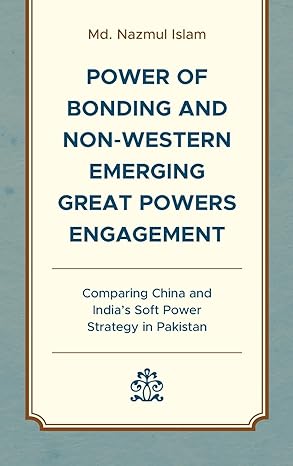
Power of Bonding and Non-Western Emerging Great Powers Engagement: Comparing China and India’s Soft Power Strategy in Pakistan
by: Md. Nazmul Islam (Author)
Publisher: Lexington Books
Publication Date: 2023/10/30
Language: English
Print Length: 246 pages
ISBN-10: 1666920991
ISBN-13: 9781666920994
Book Description
In international politics, states often strive to maintain their position through either cooperation or force. Soft power theory has emerged as a non-violent approach for states to achieve national interest by utilizing intangible resources. China and India have both successfully employed soft power strategies to expand their influence, , and Pakistan is a relevant case study for examining the soft power of China and India, as it neighbors of both countries. The withdrawal of the United States from Afghanistan has raised questions about how India and China will engage and cooperate in dealing with Pakistan, as well as how they will fill the regional gap left by the US. Nazmul Islam considers Joseph S. Nye's Soft Power theory and develops a new idea of “Power of Bonding” based on non-Western perspectives to examine India and China's soft power strategy on Pakistan.. Additionally, it evaluates their areas of influence and soft power strategy in three thematic areas: political and diplomatic engagement, cultural attributions and attraction for power bonding, and economic partnerships. To accomplish these objectives, the study relies on various research methods, including content analysis of articles published in Pakistan's Dawn newspaper, and one-on-one interviews with participants from Pakistan, India, and China.
About the Author
In international politics, states often strive to maintain their position through either cooperation or force. Soft power theory has emerged as a non-violent approach for states to achieve national interest by utilizing intangible resources. China and India have both successfully employed soft power strategies to expand their influence, , and Pakistan is a relevant case study for examining the soft power of China and India, as it neighbors of both countries. The withdrawal of the United States from Afghanistan has raised questions about how India and China will engage and cooperate in dealing with Pakistan, as well as how they will fill the regional gap left by the US. Nazmul Islam considers Joseph S. Nye's Soft Power theory and develops a new idea of “Power of Bonding” based on non-Western perspectives to examine India and China's soft power strategy on Pakistan.. Additionally, it evaluates their areas of influence and soft power strategy in three thematic areas: political and diplomatic engagement, cultural attributions and attraction for power bonding, and economic partnerships. To accomplish these objectives, the study relies on various research methods, including content analysis of articles published in Pakistan's Dawn newspaper, and one-on-one interviews with participants from Pakistan, India, and China. Read more
Power of Bonding and Non-Western Emerging Great Powers Engagement: Comparing China and India’s Soft Power Strategy in Pakistan
未经允许不得转载:电子书百科大全 » Power of Bonding and Non-Western Emerging Great Powers Engagement: Comparing China and India’s Soft Power Strategy in Pakistan
相关推荐
 The Man Who Invented Fiction: How Cervantes Ushered in the Modern World Reprint Edition
 What We Keep Forgetting About Technology: Lessons for Digital Innovators
 The War on Reality: Recovering Truth in a World That Celebrates Lies
 Progressive Industrial Policy in Europe
 Introducing Philosophy : Questions and Readings
 Philosophy: A Text With Readings 7th Edition
 Killer Psychopaths: The Inside Story of Criminal Profiling
 The Carbon Wave: A Story of Democracy, Parenthood, and the Race to Protect Our Planet
评论前必须登录!
立即登录 注册