 电子书百科大全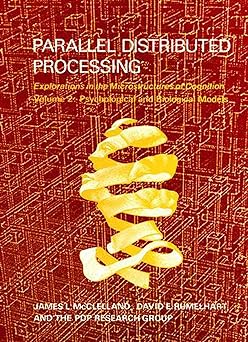
Parallel Distributed Processing, Vol. 2: Psychological and Biological Models
by: James L. Mcclelland (Author),David E. Rumelhart(Author),PDP Research Group(Author)
Publication Date: 1987/7/29
Language: English
Print Length: 632 pages
ISBN-10: 9780262631105
ISBN-13: 9780262631105
Book Description
What makes people smarter than computers? These volumes by a pioneering neurocomputing group suggest that the answer lies in the massively parallel architecture of the human mind. They describe a new theory of cognition called connectionism that is challenging the idea of symbolic computation that has traditionally been at the center of debate in theoretical discussions about the mind. The authors' theory assumes the mind is composed of a great number of elementary units connected in a neural network. Mental processes are interactions between these units which excite and inhibit each other in parallel rather than sequential operations. In this context, knowledge can no longer be thought of as stored in localized structures; instead, it consists of the connections between pairs of units that are distributed throughout the network. Volume 1 lays the foundations of this exciting theory of parallel distributed processing, while Volume 2 applies it to a number of specific issues in cognitive science and neuroscience, with chapters describing models of aspects of perception, memory, language, and thought.
About the Author
What makes people smarter than computers? These volumes by a pioneering neurocomputing group suggest that the answer lies in the massively parallel architecture of the human mind. They describe a new theory of cognition called connectionism that is challenging the idea of symbolic computation that has traditionally been at the center of debate in theoretical discussions about the mind. The authors' theory assumes the mind is composed of a great number of elementary units connected in a neural network. Mental processes are interactions between these units which excite and inhibit each other in parallel rather than sequential operations. In this context, knowledge can no longer be thought of as stored in localized structures; instead, it consists of the connections between pairs of units that are distributed throughout the network. Volume 1 lays the foundations of this exciting theory of parallel distributed processing, while Volume 2 applies it to a number of specific issues in cognitive science and neuroscience, with chapters describing models of aspects of perception, memory, language, and thought. Read more
Parallel Distributed Processing, Vol. 2: Psychological and Biological Models
相关推荐
 Parasites in Our World
 The Biological Activity of Phytochemicals 2011th Edition
 A Primer For Experimental Evolution
 Treatise on Geochemistry 2nd Edition
 The Pharmagellan Guide to Analyzing Biotech Clinical Trials
 Non-invasive Prenatal Screening (NIPS) in Clinical Practice
 Water Crises and Sustainable Management in the Global South
 The Mongolian Gerbil Brain: Mitochondrial Function, Vasculature, and Pathophysiological States
评论前必须登录!
立即登录 注册