 电子书百科大全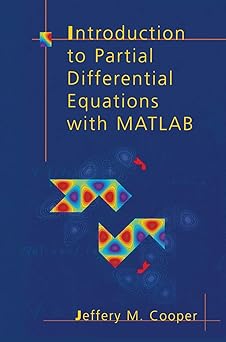
Introduction to Partial Differential Equations with MATLAB (Applied and Numerical Harmonic Analysis)
by: Jeffery M. Cooper (Author)
Publisher: Birkhäuser
Edition: Softcover reprint of the original 1st ed. 1998
Publication Date: 2012/10/31
Language: English
Print Length: 556 pages
ISBN-10: 1461272661
ISBN-13: 9781461272663
Book Description
Overview The subject of partial differential equations has an unchanging core of material but is constantly expanding and evolving. The core consists of solution methods, mainly separation of variables, for boundary value problems with constant coeffi cients in geometrically simple domains. Too often an introductory course focuses exclusively on these core problems and techniques and leaves the student with the impression that there is no more to the subject. Questions of existence, uniqueness, and well-posedness are ignored. In particular there is a lack of connection between the analytical side of the subject and the numerical side. Furthermore nonlinear problems are omitted because they are too hard to deal with analytically. Now, however, the availability of convenient, powerful computational software has made it possible to enlarge the scope of the introductory course. My goal in this text is to give the student a broader picture of the subject. In addition to the basic core subjects, I have included material on nonlinear problems and brief discussions of numerical methods. I feel that it is important for the student to see nonlinear problems and numerical methods at the beginning of the course, and not at the end when we run usually run out of time. Furthermore, numerical methods should be introduced for each equation as it is studied, not lumped together in a final chapter.
About the Author
Overview The subject of partial differential equations has an unchanging core of material but is constantly expanding and evolving. The core consists of solution methods, mainly separation of variables, for boundary value problems with constant coeffi cients in geometrically simple domains. Too often an introductory course focuses exclusively on these core problems and techniques and leaves the student with the impression that there is no more to the subject. Questions of existence, uniqueness, and well-posedness are ignored. In particular there is a lack of connection between the analytical side of the subject and the numerical side. Furthermore nonlinear problems are omitted because they are too hard to deal with analytically. Now, however, the availability of convenient, powerful computational software has made it possible to enlarge the scope of the introductory course. My goal in this text is to give the student a broader picture of the subject. In addition to the basic core subjects, I have included material on nonlinear problems and brief discussions of numerical methods. I feel that it is important for the student to see nonlinear problems and numerical methods at the beginning of the course, and not at the end when we run usually run out of time. Furthermore, numerical methods should be introduced for each equation as it is studied, not lumped together in a final chapter. Read more
Introduction to Partial Differential Equations with MATLAB (Applied and Numerical Harmonic Analysis)
未经允许不得转载:电子书百科大全 » Introduction to Partial Differential Equations with MATLAB (Applied and Numerical Harmonic Analysis)
相关推荐
 Contemporary Advancement in Evolutionary Multi-objective Optimization
 Nonlinear Functional Analysis Softcover Reprint of the Original 1st 1985 ed. Edition
 Sequential Experiments with Primes Softcover Reprint of the Original 1st 2017 ed. Edition
 Algebra and Discrete Mathematics for Economics: Numbers, Graphs and Matrices in Input-Output Economics
 Simulating Continuous Fuzzy Systems
 Quantenmechanik (nicht nur) für Lehramtsstudierende: Theoretische Grundlagen für die Lehre sowie Anwendungen in der Philosophie und Geschichte der Physik 2. Auflage 2026 Edition
 Managing and Understanding Artificial Intelligence: From Classical to Generative AI: A Practice Guide for Decision-makers, Developers and Regulators in the Age of the EU AI Act
 Diskrete Mathematik: Differenzen, Graphen, Spielpläne, Lineare Optimierung (De Gruyter Studium)
评论前必须登录!
立即登录 注册