 电子书百科大全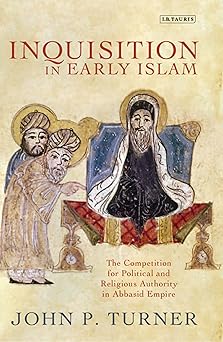
Inquisition in Early Islam: The Competition for Political and Religious Authority in the Abbasid Empire (Library of Middle East History)
by: John P. Turner (Author)
Publisher: I.B. Tauris
Publication Date: 2013/5/15
Language: English
Print Length: 248 pages
ISBN-10: 1780761643
ISBN-13: 9781780761640
Book Description
In 833 CE, the Abbasid Caliph al-Ma'mun began a period of inquisition (mihna), one which continued until his successor al-Mutawakkil decreed its end, fifteen years later. During this period, the Caliphs in power strove to promote 'correct belief' in the 'createdness' of the Qur'an, thus ordering the interrogation of religious scholars on the subject and disqualifying, beating or even executing those who answered incorrectly. Here, John P. Turner examines and analyses this major episode, viewing it as the pivotal point for the era in question and ultimately for the state of relations between the temporal authorities and religious law. Inquisition in Early Islam focuses on the shifting control over matters of belief and orthodoxy, from the Caliph to the religious scholars, and explores the relationships between heresy, power and the articulation and definition of law and doctrine. Turner does so by exploring the mihna within its context, asking questions such as, why was it so pivotal? Why was it begun? Why did it end? When did the meaning of the Caliph's position in society shift?How did the Caliph lose his ability to assert himself in defining the boundaries and beliefs of religion? And why and when do the religious/legal scholars gain independence and control over the elaboration and interpretation of the law? By examining the definition of 'heresy' as conceived of by the Caliphs, Turner presents a vivid account of the heresy trials during this period, as well as an insightful analysis of the nature of rule and religion. Through investigating heretics and heresy in this period, Turner highlights the Caliph's social role, exploring the relationships between orthodoxy, heresy, power and authority in a context where there was no single arbiter of dogma. This book is therefore of particular interest to researchers and scholars of Islamic history as well as of comparative religion and medieval history.
About the Author
In 833 CE, the Abbasid Caliph al-Ma'mun began a period of inquisition (mihna), one which continued until his successor al-Mutawakkil decreed its end, fifteen years later. During this period, the Caliphs in power strove to promote 'correct belief' in the 'createdness' of the Qur'an, thus ordering the interrogation of religious scholars on the subject and disqualifying, beating or even executing those who answered incorrectly. Here, John P. Turner examines and analyses this major episode, viewing it as the pivotal point for the era in question and ultimately for the state of relations between the temporal authorities and religious law. Inquisition in Early Islam focuses on the shifting control over matters of belief and orthodoxy, from the Caliph to the religious scholars, and explores the relationships between heresy, power and the articulation and definition of law and doctrine. Turner does so by exploring the mihna within its context, asking questions such as, why was it so pivotal? Why was it begun? Why did it end? When did the meaning of the Caliph's position in society shift?How did the Caliph lose his ability to assert himself in defining the boundaries and beliefs of religion? And why and when do the religious/legal scholars gain independence and control over the elaboration and interpretation of the law? By examining the definition of 'heresy' as conceived of by the Caliphs, Turner presents a vivid account of the heresy trials during this period, as well as an insightful analysis of the nature of rule and religion. Through investigating heretics and heresy in this period, Turner highlights the Caliph's social role, exploring the relationships between orthodoxy, heresy, power and authority in a context where there was no single arbiter of dogma. This book is therefore of particular interest to researchers and scholars of Islamic history as well as of comparative religion and medieval history. Read more
Inquisition in Early Islam: The Competition for Political and Religious Authority in the Abbasid Empire (Library of Middle East History)
未经允许不得转载:电子书百科大全 » Inquisition in Early Islam: The Competition for Political and Religious Authority in the Abbasid Empire (Library of Middle East History)
相关推荐
 An Introduction to Christian Theology (Introduction to Religion)
 Fabricating Religion: Fanfare for the Common e.g.
 Religions Are Remixes (Routledge Studies in Religion)
 Knowledge and God (Elements in Epistemology)
 Between Science and Religion: The Engagement of Catholic Intellectuals with Science and Technology in the Twentieth Century
 Leo Strauss and the Theologico-Political Problem (Modern European Philosophy)
 Critical Questions in Contemporary Theology: Essays in Honour of Dermot A. Lane (Studies in Theology, Society and Culture)
 Refiguring the Sacred: Conversations with Paul Ricoeur (Studies in the Thought of Paul Ricoeur)
评论前必须登录!
立即登录 注册