 电子书百科大全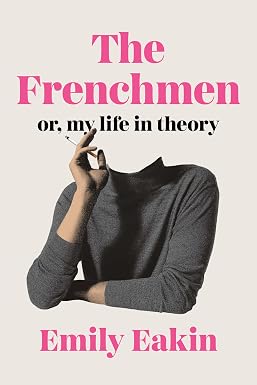
The Frenchmen: Or, My Life in Theory
Author(s): Emily Eakin (Author)
- Publisher: Penguin Press
- Publication Date: July 21, 2026
- Language: English
- Print length: 496 pages
- ISBN-10: 1594206325
- ISBN-13: 9781594206320
Book Description
“A superbly engrossing adventure of ideas...this will surely be my philosophy book of the year.” —Sarah Bakewell,
New York Times bestselling author of Humanly PossibleFrom leading critic and essayist Emily Eakin, a stylish personal history of French theory and its unlikely domination of American culture
When Emily Eakin arrived at Harvard in the late 1980s, she fell under the spell of an eclectic body of philosophical texts by a handful of French authors. This was French theory, a set of recondite ideas that had taken American campuses by a storm during the preceding decades. In retrospect, the influence of these men and their writings seems both extraordinary and improbable. The Frenchmen argued that language is all-powerful, meaning unstable, and the self is an illusion. Their prose was brilliant, dazzling even, but often mystifyingly elaborate and highly abstract. Yet American students and scholars flocked to their books and lectures, intoxicated by a powerful new means of understanding—and perhaps even changing—the world. For Eakin, an unsophisticated graduate of a small-town Midwestern high school, theory was no mere intellectual exercise but a way of being—a heady shortcut to worldly glamour and wisdom.
The Frenchmen is the story of Eakin’s youthful love affair with French theory, alongside a wider examination of its rise and fall. Looking closely at Jacques Derrida, Louis Althusser, Roland Barthes, Gilles Deleuze, Michel Foucault, Félix Guattari, Jacques Lacan, and the French-speaking Belgian Paul de Man, Eakin untangles their famously difficult works with peerless, delightful clarity. What’s more, she brings to light the eccentric, scandalous—at times criminal!—lives of thinkers who themselves were often highly averse to biography, in a daringly original weave of storytelling and exegesis.As she explores the magnetism of their work, Eakin illuminates not just the Frenchmen’s enduring legacy but some of today’s deepest political, social, and intellectual arguments. She neither rejects nor flatters the Frenchmen’s ideas but instead reveals how they indelibly changed our understanding of power, truth, and identity. Eakin shows how, for better or worse, the Frenchmen continue to shape and unsettle our lives today.
Editorial Reviews
Review
“An entertaining hybrid of autobiography and intellectual history, it is outstanding not just for its lucid expositions of challenging ideas but for conveying viscerally what the encounter with them felt like in the early years of their stateside reception.”
—Compact“A spry intellectual history neatly blends with a memoir of studying modern literary theory. . . Eakin writes with admirable clarity of ideas, such as the 'always already,' the aporia, and the interpellation, and she mixes her understanding of such theories with nicely juicy bits of gossip . . . A fine account of the onetime primacy of French critical theory and its place in real life.” —Kirkus (starred review)
“Masterful . . . an engrossing portrait . . . Eakin makes her obsession with these thinkers contagious.” —
Publishers Weekly (starred review)“A superbly engrossing adventure of ideas, tracing the lives and rivalries of thinkers who were anti-humanist in their theories, but all-too-human in their personalities. I loved Emily Eakin's wry account of her own youthful intoxication with these writers, and of her disentanglement from them — even while she reassesses what they might still have to offer in these strange times. This will surely be my philosophy book of the year.” —
Sarah Bakewell, New York Times bestselling author of Humanly Possible“Rich, absorbing, seductive,
The Frenchmen is an intellectual history that doesn't leave out the body. Eakin's own coming-of-age animates her masterful portrait of ideas that changed the world and the singularly eccentric figures whose lives were almost as remarkable as their thoughts. I loved this book.” —Ayad Akhtar, Pulitzer Prize-winning author of Homeland Elegies“Who knew theory could be so much fun? Deliciously gossipy yet super-smart,
The Frenchmen illuminates the eccentric lives behind the philosophies that blew a whole generation's mind on both sides of the Atlantic. Emily Eakin's sparkling prose lets us relive the thrill of their intellectual chase—and shows why it still matters. Refusing to settle for easy judgments, this immensely enjoyable book reveals the making of a new world of thought, where philosophy overflows into politics, sex, and art.” —Clare Carlisle, author of Philosopher of the Heart: The Restless Life of Søren Kierkegaard“Eakin delivers exactly what we want: a panoramic and intellectually wised-up chronicle of the High Theory with which France seduced America, plus all the High Drama behind it: rivalries, takedowns, political ructions, betrayals, drugs, madness, uxoricide, fraud (not all of it intellectual), and jouissance (not all of it sexual). It's an opera of ideas, and an absurdly entertaining one.” —
Jim Holt, bestselling author of Why Does the World Exist?About the Author
Excerpt. © Reprinted by permission. All rights reserved.
I came under the Frenchmen's spell in the late 1980s, as an eighteen-year-old Harvard sophomore at the height of America's theory craze. In the spiral notebook my roommates and I kept under a corner of our living room rug-our "Under the Rug Book"-we recorded jokes, fragments of conversation, passages from our reading. My roommates, English majors both, jotted lines from Milton and
Wuthering Heights. I, a literature concentrator-the college's name for theory-centered studies-copied out paragraphs from Derrida. References to theory crept into my papers, so that an essay on Wordsworth for a course on nineteenth-century English poetry included an allusion, indecipherable to me now, to a "sunny Derridean plateau."By then, I had concluded that the English department was tweedy and old-fashioned, a bastion of conventionality and received wisdom. By contrast, the literature department, just a few years old when I got to campus, struck me as cutting edge, attracting some of the most brilliant students around. They were also a little intimidating. These were the students who lingered in the dining hall after dinner, discussing Nietzsche's
Übermensch and logical aporias in Plato's Symposium. The way they talked about language, they seemed to know things the rest of us didn't-how slippery meaning was, how words didn't express or reflect reality so much as fashion it. Maybe reality was just that, they implied: words. And theory was what they talked with-a constant touchstone. It was their common currency, their secret code, their drug.In the beginning, I was like Madeleine, the heroine of
The Marriage Plot, Jeffrey Eugenides' comic novel about a senior at Brown in the 1980s, an earnest suburbanite who comes to college intent on studying English literature because of her love of Dickens, Wharton, and James. She soon finds herself surrounded by students dressed in "Doc Martens and anarchist symbols" who casually name-drop thinkers she's never heard of. "Derrida is my absolute god!" Madeleine's roommate declares in a typical-and, to Madeleine, baffling-aside.Determined to understand this strange cult, Madeleine signs up for Semiotics 211, an upper-level seminar. Derrida was in the air, godlike, at Harvard and, like Madeleine, I wanted access to the sanctum. I was from Bloomington, Indiana, a midsize Midwestern college town-so not the suburbs, and hardly the boondocks, but still sorely lacking, it seemed to me, in intellectual hipness. Who was this one-name Frenchman, anyway?
I was interested in French, and I was interested in intellectuals, or at least in being mistaken for one. Toward this end, I had taken a first step the year before college, spending it on a program for high school students in Rennes, in northwestern France, from which I'd returned nearly fluent. I'd found the flier advertising the program in the wastebasket of my father's study (an unexpected perk of having to collect the family trash-a chore I shared on a rotating basis with my three siblings). My teenage fantasies about France were vague and romantic, inspired as much by real estate ads at the back of
The New York Times Magazine ("17th-century château in Limoges; 15 bdrms, 4 baths, 29 forested hectares, family-owned for more than 300 years!") as any book I happened to have read.But there was also Suzy, a girl in my high school who had gone with her family to Geneva for a year and come back not only fluent in French but transformed, with a black leather jacket, a nose ring, a handmade zine operation, and a low tolerance for us, her former friends, who, it was clear, she now found hopelessly provincial. Suzy had turned punk and urbane while the rest of us were giggling in sleeping bags on someone's rec room rug and trawling the mall for fuzzy cardigans on markdown. As it had been for so many Americans before me-including characters in the novels by Henry James that my father, an English professor, taught at the local university-Europe beckoned as an essential stop on the road to worldly sophistication and glamour.
My parents implicitly encouraged this view. For my father's first sabbatical, when I was four, we had lived in Paris, where my little sister and I attended the
maternelle and my older sister completed first grade at a local public school. Seven years later, another sabbatical, this one in Athens, where we went to a British school, now with the addition of my baby brother. In both cities, weekends and holidays were for touring museums and archaeological sites-in a word, for Culture, the thing that lurked in Doric capitals and within six-foot gilt frames, the ones we peered at over stanchions and red-velvet rope. Our French had grown rusty since that first trip, but the muscle memory was there, resurfacing at random in phrases that had blended unremarked into the family idiom-"On y va, alors?" "À table!" "Dégueulasse!"Yet there was something particular about France, something I could not have expressed at the time but that as I grew older factored into its allure: the idea that it was the country-and French the language-of intellectuals. I had seen photos of my father in Paris from January 1960, during a postcollege year abroad. Seated in his student hotel room in the Latin Quarter, in a dark turtleneck sweater and black frame glasses-the signature existentialist look, though I didn't know it then-he is holding up a copy of the leftist newspaper
Combat, with the shocked headline: Albert Camus est mort. I had never heard of Camus. But that the death of such a person was front-page news made an impression.I could not have put the thought into words, but the message wafting subliminally from those photos was that what was meant by "life of the mind" was France. And by this logic there was little more French than theory.
As it turned out, I did not meet any intellectuals, French or otherwise, during my senior year of high school in Rennes. Instead, I got to know a couple dozen students from East Coast prep schools-the majority of the kids in the program. These encounters supplied more confirmation that Suzy had been right: I was provincial. I had cut my hair in a Louise Brooks bob before the trip, but no one was fooled by my Jazz Age veneer. The other students had clearly read more, drunk more, smoked more-done more-than I had. As far as I could tell, the main reason some had come to France was to be able to indulge more freely: no drinking age, no dorm proctors, no parents, no prohibitions. Many had credit cards. John, pale, blond, and bony, from New York City via Exeter, slunk around the nineteenth-century villa where we took our classes, wearing a secondhand red-satin smoking jacket and strumming a guitar. The nickname for Prescott, the long-lashed, dark-haired boy, from New York City via Andover, who became my first serious boyfriend, was "Marlboro Man." We spent hours after school in the café down the street, which had both a foosball table and beer on tap-a seductive combination for teenagers playing at being adults.
"You are a babe in the woods among tigers," the wife of the program's director told me, with what I took to be motherly concern. For the most part, though, my new friends were protective, not scornful, of my innocence. When John acquired a few tabs of LSD, and a group of us went to the sprawling green Parc du Thabor in the city center to take them, it was decided that I, alone, would not be getting high. "I don't think it would be a good idea," John said, not unkindly. "You're already tripping."
John wasn't wrong. My journal from that year overflows with exclamation points-"I'm running out of new superlatives," I exulted early on. The French franc was at ten to the dollar; American high school students with unfettered access to their parents' Visas could live extremely well, and my friends were nothing if not generous. When the midterm break arrived that fall, we took the train to Paris, where we drank Scotch, dined at Michelin-rated restaurants and overpriced tourist joints ("P. had snails, I had artichoke hearts, and beef with olives," I dutifully recorded about a meal at La Coupole), toured Notre Dame, climbed the Eiffel Tower ("cliché but true: breathtaking, awesome, beautiful at night!"), went to the ballet and a disco, and slept four to a room at the Grand Hotel Oriental off the rue des Écoles. Except for the night when we arrived at the front door in the wee hours to find it locked and were forced to retreat down the hill to the banks of the Seine, where, tipsy and shivering, we watched the sunrise in the company of some local drunks. I was sixteen years old and living in a chapter from Hemingway's
A Moveable Feast, the one where he declares: "All Paris belongs to me.""I tried to express how lucky I felt to know them, because of my middle-class Hoosier normality," I wrote in my journal about my new friends. "I realize how different, how much less deep and wide, I would be had I remained at home. Last night I took a big step away from Mini, Erika, Janet, and Jean"-high school friends back in Indiana-"a step I had taken long ago, but only now am I able to look back and see the imprint of my feet yards behind me."
◆◆◆
Theory would be another giant step along my path to worldliness, a bildungsroman I was only dimly aware I was writing. In the spring of my freshman year in college, I was cast in an experimental adaptation of Chekhov’s
The Seagull, which is how I met Mark, a sophomore literature concentrator, and his roommate, Jason, a history major and pianist who spoke accentless French and was obsessed with Huysmans, Baudelaire, and other exemplars of the nineteenth-century French Decadent Movement. The plot of The Seagull, which revolves around the romantic triangles of a group of struggling writers and actors, in our version became a series of striking tableaux. Dressed in black formal wear, we rushed onstage to the jubilant opening chords of Mendelssohn’s Italian Symphony. At one point, the stage directions called for Jason to deposit me atop a baby grand piano; there may have been a rose in his hand or my mouth."It was unmistakable that you were an innocent," Mark told me recently, "high culture laminated on Midwestern innocence." Tall, dark, artistic, and brainy, Mark was from suburban Massachusetts via Exeter (do you see a pattern here?) and already into theory. "It would be hard to overstate how simply cool theory was," he says. "The aura surrounding that stuff was pretty intense." He doesn't recall the circumstances of his "first contact," nor do I mine, but I'm pretty sure that his enthusiasm for theory was a draw. We soon embarked on an on-again, off-again romance, and by the following fall, I'd declared myself a literature concentrator too.
Like many theory heads, Mark and Jason lived in Adams House, a red brick Victorian pile off Harvard Yard, originally intended as luxury accommodations for the college's wealthiest students. In the 1980s, housing for upperclassmen was still assigned according to student-ranked choices in a lottery system (rather than randomly, as it is now), and Adams, known for its literary and artistic bent, was the place I wanted to be. In 1978, a young Peter Sellars staged
Antony and Cleopatra in the ornate marble-lined swimming pool in the basement. ("At one end floats Cleopatra's sturdy raft; at the other, the diving board extends over the water like an erect phallus," the reviewer for The Harvard Crimson wrote.) A decade later, in the humid half-darkness, I attended a hypnotic performance of "Inlets," a composition by John Cage featuring the otherworldly sound of water flowing through conch shells. By the end of the concert, I was floating on my back in the pool, along with the rest of the audience. That must have been one of the last such aquatic extravaganzas in Adams House. Notorious for late-night skinny-dipping parties, and a source of paranoia about AIDS in the days before the disease was well understood, the pool was closed for good the year after I graduated.In Adams House, whose rooms were occupied by actors, musicians, and performers of every stripe, everyday life could take on a theatrical air. My roommates and I met the boys across the hall when they slipped a folded piece of paper under our door. Featuring a hand-drawn image of a flower, its petaled head snapped and tumbling from its stem, the card was an invitation to a "deflowering" party for a woman in the house named Elizabeth. She had recently lost her virginity, and, with her blessing, her friends had organized a public celebration. (She would go on to fame as the author of
Prozac Nation, an early memoir of life on the antidepressant.)Theory, too, could have a self-conscious, performative aspect, along with a whiff of rebellion. After all, we were a generation embarking on adulthood at a moment of unusual quiescence. Ronald Reagan, president when we began high school, would still be president until a few months before we graduated from college, when he would be succeeded by his former vice president in an election suggesting widespread public approval of his conservative revolution. The anti-war demonstrations that had roiled campuses the decade before we arrived had disappeared, as well as, apparently, any organized opposition. The culture wars had yet to ignite; the AIDS crisis had not yet penetrated the national consciousness. Politics seemed to have gone dormant, its focus elsewhere, expressions of dissent reduced to a "shantytown" in Harvard Yard protesting the university's investments in apartheid South Africa. In an era of complacency and self-satisfaction, theory was a symbol, however small, of intellectual nonconformism, a badge, like a pink mohawk, that marked you as a member of the counterculture, different from-and critical of-the docile horde.
Directly across Bow Street from Adams House's rear façade was Café Pamplona, or, as Mark recalled it, "a useful simulacrum of Parisian space": a tiny, subterranean coffee shop with an even tinier kitchen and a black-clad, male-only waitstaff that serviced an equally black-clad student clientele, a species conversant in theory. The only thing anyone seems to remember eating there is gazpacho. Mostly we went for the espresso frappé-served cold, in a tall skinny glass topped with whipped cream-and to check out who else was there. Mark and Jason both waited tables there, though no one worked at Pamplona for the money-a piddly $2.01 an hour before tips. Like theory, the job was something you did because it was cool; working there was another way of advertising to the world your superior status.




评论前必须登录!
立即登录 注册