 电子书百科大全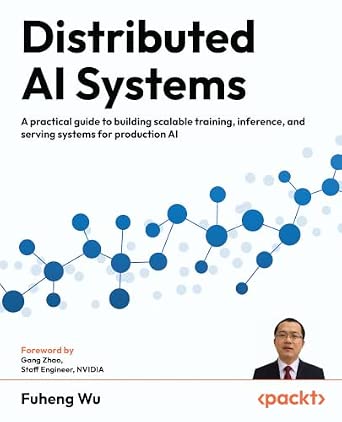
Distributed AI Systems: A practical guide to building scalable training, inference, and serving systems for production AI
Author(s): Fuheng Wu (Author)
- Publisher: Packt Publishing
- Publication Date: 29 Jun. 2026
- Language: English
- Print length: 558 pages
- ISBN-10: 1807301710
- ISBN-13: 9781807301712
Book Description
Learn distributed AI through hands-on experience with training frameworks, inference engines, and orchestration tools to build production-ready training, inference, and serving systems for modern large-scale AI.
Free with your book: DRM-free PDF version + access to Packt's next-gen Reader*
Key Features
- Understand GPU hardware, high-speed interconnects, and parallelism strategies
- Hands-on exercises at the end of every chapter
- Learn distributed training with resource-optimized techniques
- Deploy high-performance inference with advanced optimization and memory management
- Build production serving stacks with job schedulers, orchestration, and observability
Book Description
As AI models grow to billions and trillions of parameters, distributed systems are essential for training and serving them. Many resources cover fragments of this domain, but none provide a full path from distributed training to inference and production deployment. This book fills that gap with practical, production-focused examples.
It starts with GPU and memory estimation, data preparation, and an overview of GPU architecture, interconnects, and core parallelism strategies. You’ll learn training techniques including data parallelism for single and multi-node setups, parameter sharding for memory-efficient scaling, and methods to reduce memory usage in large models.
The next section covers distributed inference and deployment. You’ll build high-performance systems using optimized attention, caching, operator fusion, and router-based designs. You’ll deploy on schedulers and container platforms with GPU-aware orchestration and assemble production stacks emphasizing reliability, scalability, and observability.
The final section covers benchmarking, performance tuning, and trends like MoE models, edge-cloud coordination, and advanced parallelism. Each chapter includes tested code and debugging guidance.
By the end, you’ll be able to build distributed AI systems that scale from a single GPU to large clusters.
What you will learn
- Estimate memory and compute requirements for training and inference
- Understand GPU hardware, interconnects, and parallelism strategies
- Implement distributed training with parallel and sharded techniques
- Build production inference systems with batching and memory management
- Deploy via cluster orchestration with optimized GPU scheduling
- Create production serving stacks with routing and observability
- Benchmark distributed systems using industry-standard methodologies
- Explore emerging model trends, scaling strategies, and future paths
Who this book is for
This book is designed for ML engineers, AI researchers, and DevOps professionals who need to train or serve large AI models at scale. Platform engineers, HPC cluster administrators, and cloud architects will also find it valuable for advancing their skill sets.
A basic understanding of Python and PyTorch is required to get started. Prior experience with distributed systems, cluster schedulers, or container orchestration is helpful but not necessary - the book introduces these concepts from the ground up, beginning with resource estimation, data preparation, and hardware fundamentals.
Table of Contents
- Introduction to Modern Distributed AI
- GPU Hardware, Networking, and Parallelism Strategies
- Distributed Training with PyTorch DDP
- Scaling with Fully Sharded Data Parallel (FSDP)
- Beyond State Sharding with DeepSpeed and Megatron
- Distributed Inference and vLLM
- Cross-Request Optimization with SGLang
(N.B. Please use the Read Sample option to see further chapters)
Editorial Reviews
About the Author
Henry (Fuheng) Wu is a Principal Machine Learning Tech Lead at Oracle's Generative AI organization, specializing in distributed training, large-scale inference, and GPU systems. He has delivered core components of Oracle's Vision and Document Understanding AI services, and co-authored a Microsoft and Oracle blog on high-performance deep learning. He has contributed to open-source projects including SGLang, genai-bench, pyLLaMA, chatLLaMA, and Oracle's HiQ observability system. With hands-on experience across PyTorch Distributed, DeepSpeed, Kubernetes GPU clusters, and production LLM serving, he focuses on building practical, scalable AI systems used in real-world enterprise workloads.


评论前必须登录!
立即登录 注册