 电子书百科大全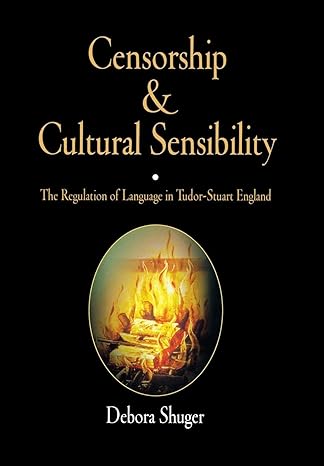
Censorship and Cultural Sensibility: The Regulation of Language in Tudor-Stuart England
by: Debora Shuger (Author)
Publisher: University of Pennsylvania Press
Publication Date: 2006/3/21
Language: English
Print Length: 360 pages
ISBN-10: 0812239172
ISBN-13: 9780812239171
Book Description
In this study of the reciprocities binding religion, politics, law, and literature, Debora Shuger offers a profoundly new history of early modern English censorship, one that bears centrally on issues still current: the rhetoric of ideological extremism, the use of defamation to ruin political opponents, the grounding of law in theological ethics, and the terrible fragility of public spheres. Starting from the question of why no one prior to the mid-1640s argued for free speech or a free press per se, Censorship and Cultural Sensibility surveys the texts against which Tudor-Stuart censorship aimed its biggest guns, which turned out not to be principled dissent but libels, conspiracy fantasies, and hate speech. The book explores the laws that attempted to suppress such material, the cultural values that underwrote this regulation, and, finally, the very different framework of assumptions whose gradual adoption rendered censorship illegitimate.Virtually all substantive law on language concerned defamation, regulating what one could say about other people. Hence Tudor-Stuart laws extended protection only to the person hurt by another's words, never to their speaker. In treating transgressive language as akin to battery, English law differed fundamentally from papal censorship, which construed its target as heresy. There were thus two models of censorship operative in the early modern period, both premised on religious norms, but one concerned primarily with false accusation and libel, the other with false belief and immorality. Shuger investigates the first of these models—the dominant English one—tracing its complex origins in the Roman law of iniuria through medieval theological ethics and Continental jurisprudence to its continuities and discontinuities with current U.S. law. In so doing, she enables her reader to grasp how in certain contexts censorship could be understood as safeguarding both charitable community and personal dignitary rights.
About the Author
In this study of the reciprocities binding religion, politics, law, and literature, Debora Shuger offers a profoundly new history of early modern English censorship, one that bears centrally on issues still current: the rhetoric of ideological extremism, the use of defamation to ruin political opponents, the grounding of law in theological ethics, and the terrible fragility of public spheres. Starting from the question of why no one prior to the mid-1640s argued for free speech or a free press per se, Censorship and Cultural Sensibility surveys the texts against which Tudor-Stuart censorship aimed its biggest guns, which turned out not to be principled dissent but libels, conspiracy fantasies, and hate speech. The book explores the laws that attempted to suppress such material, the cultural values that underwrote this regulation, and, finally, the very different framework of assumptions whose gradual adoption rendered censorship illegitimate.Virtually all substantive law on language concerned defamation, regulating what one could say about other people. Hence Tudor-Stuart laws extended protection only to the person hurt by another's words, never to their speaker. In treating transgressive language as akin to battery, English law differed fundamentally from papal censorship, which construed its target as heresy. There were thus two models of censorship operative in the early modern period, both premised on religious norms, but one concerned primarily with false accusation and libel, the other with false belief and immorality. Shuger investigates the first of these models—the dominant English one—tracing its complex origins in the Roman law of iniuria through medieval theological ethics and Continental jurisprudence to its continuities and discontinuities with current U.S. law. In so doing, she enables her reader to grasp how in certain contexts censorship could be understood as safeguarding both charitable community and personal dignitary rights. Read more
Censorship and Cultural Sensibility: The Regulation of Language in Tudor-Stuart England
未经允许不得转载:电子书百科大全 » Censorship and Cultural Sensibility: The Regulation of Language in Tudor-Stuart England
相关推荐
 The History of Anti-Semitism, Volume 3: From Voltaire to Wagner
 International Solidarity in the Low Countries during the Twentieth Century: New Perspectives and Themes
 300 Years of the French in Old Mines: A Narrative History of the Oldest Village in Missouri
 Escape from the Pit: A Woman's Resistance in Nazi-occupied Poland, 1939-1943 (Excelsior Editions)
 Alexandrine Teaching on the Universe (Routledge Revivals)
 Dynamic Repetition: History and Messianism in Modern Jewish Thought (The Tauber Institute Series for the Study of European Jewry)
 The Latin Continuation of William of Tyre (Crusade Texts in Translation)
 Shmuel Hugo Bergmann: A Life between Prague and Jerusalem (Europäisch-jüdische Studien – Beiträge, 63)
评论前必须登录!
立即登录 注册