
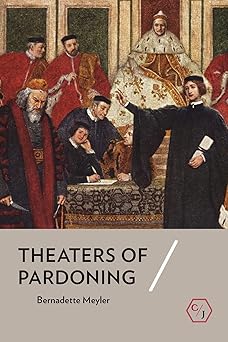
Theaters of Pardoning (Corpus Juris: The Humanities in Politics and Law)
by: Bernadette Meyler (Author)
Publisher: Cornell University Press
Publication Date: 2019/9/15
Language: English
Print Length: 324 pages
ISBN-10: 1501739344
ISBN-13: 9781501739347
Book Description
From Gerald Ford’s preemptive pardon of Richard Nixon and Donald Trump’s claims that as president he could pardon himself to the posthumous royal pardon of Alan Turing, the power of the pardon has a powerful hold on the political and cultural imagination. In Theaters of Pardoning, Bernadette Meyler traces the roots of contemporary understandings of pardoning to tragicomic “theaters of pardoning” in the drama and politics of seventeenth-century England. Shifts in how pardoning was represented on the stage and discussed in political tracts and in Parliament reflected the transition from a more monarchical and judgment-focused form of the concept to an increasingly parliamentary and legislative vision of sovereignty.Meyler shows that on the English stage, individual pardons of revenge subtly transformed into more sweeping pardons of revolution, from Shakespeare’s Measure for Measure, where a series of final pardons interrupts what might otherwise have been a cycle of revenge, to later works like John Ford’s The Laws of Candy and Philip Massinger’s The Bondman, in which the exercise of mercy prevents the overturn of the state itself. In the political arena, the pardon as a right of kingship evolved into a legal concept, culminating in the idea of a general amnesty, the “Act of Oblivion,” for actions taken during the English Civil War. Reconceiving pardoning as law-giving effectively displaced sovereignty from king to legislature, a shift that continues to attract suspicion about the exercise of pardoning. Only by breaking the connection between pardoning and sovereignty that was cemented in seventeenth-century England, Meyler concludes, can we reinvigorate the pardon as a democratic practice.
About the Author
From Gerald Ford’s preemptive pardon of Richard Nixon and Donald Trump’s claims that as president he could pardon himself to the posthumous royal pardon of Alan Turing, the power of the pardon has a powerful hold on the political and cultural imagination. In Theaters of Pardoning, Bernadette Meyler traces the roots of contemporary understandings of pardoning to tragicomic “theaters of pardoning” in the drama and politics of seventeenth-century England. Shifts in how pardoning was represented on the stage and discussed in political tracts and in Parliament reflected the transition from a more monarchical and judgment-focused form of the concept to an increasingly parliamentary and legislative vision of sovereignty.Meyler shows that on the English stage, individual pardons of revenge subtly transformed into more sweeping pardons of revolution, from Shakespeare’s Measure for Measure, where a series of final pardons interrupts what might otherwise have been a cycle of revenge, to later works like John Ford’s The Laws of Candy and Philip Massinger’s The Bondman, in which the exercise of mercy prevents the overturn of the state itself. In the political arena, the pardon as a right of kingship evolved into a legal concept, culminating in the idea of a general amnesty, the “Act of Oblivion,” for actions taken during the English Civil War. Reconceiving pardoning as law-giving effectively displaced sovereignty from king to legislature, a shift that continues to attract suspicion about the exercise of pardoning. Only by breaking the connection between pardoning and sovereignty that was cemented in seventeenth-century England, Meyler concludes, can we reinvigorate the pardon as a democratic practice. Read more

未经允许不得转载:电子书百科大全 » Theaters of Pardoning (Corpus Juris: The Humanities in Politics and Law)