
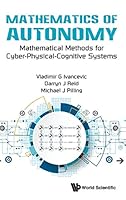
Mathematics Of Autonomy: Mathematical Methods For Cyber-physical-cognitive Systems
Author: Darryn J Reid, Michael J Pilling, Vladimir G Ivancevic
Pages: 432 pages
Edition: 1
Language: English
Publisher: World Scientific Publishing Co Pte Ltd
Publication Date: 2017-12-31
ISBN-10: 981323038X
ISBN-13: 9789813230385
Book Description
Mathematics of Autonomy provides solid mathematical foundations for building useful Autonomous Systems. It clarifies what makes a system autonomous rather than simply automated, and reveals the inherent limitations of systems currently incorrectly labeled as autonomous in reference to the specific and strong uncertainty that characterizes the environments they operate in. Such complex real-world environments demand truly autonomous solutions to provide the flexibility and robustness needed to operate well within them.
This volume embraces hybrid solutions to demonstrate extending the classes of uncertainty autonomous systems can handle. In particular, it combines physical-autonomy (robots), cyber-autonomy (agents) and cognitive-autonomy (cyber and embodied cognition) to produce a rigorous subset of trusted autonomy: Cyber-Physical-Cognitive autonomy (CPC-autonomy).
The body of the book alternates between underlying theory and applications of CPC-autonomy including “Autonomous Supervision of a Swarm of Robots” , “Using Wind Turbulence against a Swarm of UAVs” and “Unique Super-Dynamics for All Kinds of Robots (UAVs, UGVs, UUVs and USVs)” to illustrate how to effectively construct Autonomous Systems using this model. It avoids the wishful thinking that characterizes much discussion related to autonomy, discussing the hard limits and challenges of real autonomous systems. In so doing, it clarifies where more work is needed, and also provides a rigorous set of tools to tackle some of the problem space.
Readership: Undergraduates, graduates and researchers in computer science, pure and applied mathematics, engineering, and physics.
Table of Contents
Chapter 1 Introduction
Chapter 2 Physics Of The Cpc-Autonomy: Port-Hamiltonian Dynamics And Control Of Multi-Physical Networks
Chapter 3 Cpc-Application: Autonomous Brain-Like Supervisor For A Swarm Of Robots
Chapter 4 Micro-Cognitive Cpc-Autonomy: Quantum Computational Tensor Networks
Chapter 5 Cyber-Cognitive Cpc-Autonomy: Tensorflow And Deep Neural Tensor Networks
Chapter 6 Cognitive Control In Cpc-Autonomy: Perceptual Control Theory And Its Alternatives
Chapter 7 Cpc-Application: Using Wind Turbulence Against A Team Of Uavs
Chapter 8 Cognitive Estimation In Cpc-Autonomy: Recursive Bayesian Filters And Fastslam Algorithms
Chapter 9 Cpc Super-Dynamics For A Universal Large-Scale Autonomous Operation
Appendix 1: The World Of Tensors
Appendix 2: Classical Neural Networks And Ai

未经允许不得转载:电子书百科大全 » Mathematics Of Autonomy: Mathematical Methods For Cyber-physical-cognitive Systems