
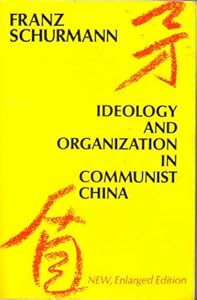
Ideology and Organization in Communist China, Second enlarged edition (Center for Chinese Studies, UC Berkeley)
Franz Schurmann (Author)
Paperback: 642 pages
Publisher: University of California Press; 2 edition (January 1, 1969)
Language: English
ISBN-10: 0520011538
ISBN-13: 9780520011533
Book Description
Publication Date: January 1, 1969 | Series: Center for Chinese Studies, UC Berkeley
First published in 1966, this book was perhaps the first one available in English dealing with the institutional history of People’s Republic of China in the 1950s. A long supplement, which covers the period from 1961 to 1966, was added two years later. In this part, Schurmann traces the origins of the Cultural Revolution in terms of ideology, organization and society and argues that the deep roots lie in the different orientations between Mao Zedong and Liu Shaoqi towards ideology and the role of party. While Liu, a pragmatist, stressed the leadership of the party in guiding and controlling the masses, Mao emphasized the importance of the spontaneity of the masses and believed that increasing bureaucratization corrupted the party and alienated the masses. This fundamental divergence, compounded with power struggles, finally caused the outbreak of the Cultural Revolution, a radical denial of the existing organizational order. Yet Schurmann notes that the Cultural Revolution was not merely guided from above. The students’ actions seemed to indicate that its driving forces also derived from society. This reexamination, however, led Schurmann to revise several important components of his earlier conclusion. For example, he changes his view with regard to differences between “professionals” and “experts,” which he earlier regarded as identical. Most important of all, he realizes that “ideology and organization are not so all-powerful as I had thought them to be. Chinese society, particularly in the form of its social classes, is asserting itself against the state, and showing that it cannot be manipulated at will.” (Preface to the second edition, viii) Nevertheless, Schurmann’s book provides much-needed insights into the complex social fabric of Communist China. As David Stafford points out, this is a “near classic, widely recognized as scholarly and authoritative.” (American Sociological Review, Vol. 34, Dec., 1969, p. 984)

未经允许不得转载:电子书百科大全 » Ideology and Organization in Communist China, Second enlarged edition