
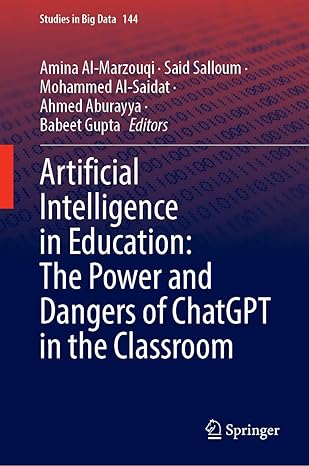
 Artificial Intelligence in Education: The Power and Dangers of ChatGPT in the Classroom: 144 (Studies in Big Data, 144)
by: Amina Al-Marzouqi (Editor),Said A. Salloum(Editor),Mohammed Al-Saidat(Editor),Ahmed Aburayya(Editor),Babeet Gupta(Editor)
Publisher: Springer
Edition: 2024th
Publication Date: 30 Mar. 2024
Language: English
Print Length: 686 pages
ISBN-10: 3031522796
ISBN-13: 9783031522796
Book Description
This book aims to bring together a collection of innovative and cutting-edge research that addresses the various challenges in the application and theoretical aspects of ChatGPT in education. ChatGPT is a large language model developed by OpenAI that has the ability to generate human-like text based on a prompt. This has significant potential for use in the field of education, as it allows for the creation of personalized, interactive learning experiences, automating assessment and grading, and more. In e-learning, ChatGPT is used to provide instant feedback and support to students, as well as generate interactive conversations in the target language for language learning. It is also integrated with existing learning management systems and educational technology platforms to enhance their capabilities. In research, ChatGPT is used for natural language processing and sentiment analysis to gather insights on student learning experiences and educational outcomes. However, it is important to note that there are also ethical and privacy concerns that come with using language models like ChatGPT in education, such as data protection and the potential for bias. Overall, the use of ChatGPT in education has the potential to revolutionize the way we learn, teach, and access information. The book seeks to publish original manuscripts that cover a broad range of topics, from the development of new chatbot technologies and their integration into the classroom, to the examination of the ethical and pedagogical implications of these systems. By compiling the latest developments in the field and highlighting new areas for exploration, this book provides valuable insights and perspectives for researchers, educators, and practitioners working in the field of ChatGPT and education. The ultimate goal is to advance the understanding of ChatGPT and its role in education and to promote its effective and responsible use in the classroom and beyond.
About the Author
From the Back Cover This book aims to bring together a collection of innovative and cutting-edge research that addresses the various challenges in the application and theoretical aspects of ChatGPT in education. ChatGPT is a large language model developed by OpenAI that has the ability to generate human-like text based on a prompt. This has significant potential for use in the field of education, as it allows for the creation of personalized, interactive learning experiences, automating assessment and grading, and more. In e-learning, ChatGPT is used to provide instant feedback and support to students, as well as generate interactive conversations in the target language for language learning. It is also integrated with existing learning management systems and educational technology platforms to enhance their capabilities. In research, ChatGPT is used for natural language processing and sentiment analysis to gather insights on student learning experiences and educational outcomes. However, it is important to note that there are also ethical and privacy concerns that come with using language models like ChatGPT in education, such as data protection and the potential for bias. Overall, the use of ChatGPT in education has the potential to revolutionize the way we learn, teach, and access information. The book seeks to publish original manuscripts that cover a broad range of topics, from the development of new chatbot technologies and their integration into the classroom, to the examination of the ethical and pedagogical implications of these systems. By compiling the latest developments in the field and highlighting new areas for exploration, this book provides valuable insights and perspectives for researchers, educators, and practitioners working in the field of ChatGPT and education. The ultimate goal is to advance the understanding of ChatGPT and its role in education and to promote its effective and responsible use in the classroom and beyond.

未经允许不得转载:电子书百科大全 » Artificial Intelligence in Education: The Power and Dangers of ChatGPT in the Classroom: 144 (Studies in Big Data, 144)